Welcome to this month’s update to find out what’s in the night sky for December.
In the Elan Valley International Dark Sky Park, astronomical darkness lasts for 11 hours and 48 minutes from 18:08 at the start of the month and 12 hours and 1 minute from 18:16 at the end. This ‘astronomical darkness’ window provides the best viewing conditions to see and capture images of distant galaxies, star clusters and nebulae.
The New Moon falls on 9th December and the Full Moon on 24th December.
The full, ‘Cold’ Moon will be the closest and brightest Supermoon of the year, appearing 14% larger and 30% brighter than a Micro Moon. A full Moon sits roughly opposite to the Sun’s low arc position, which means this month it will reach its highest position this year, staying above the horizon for much longer.
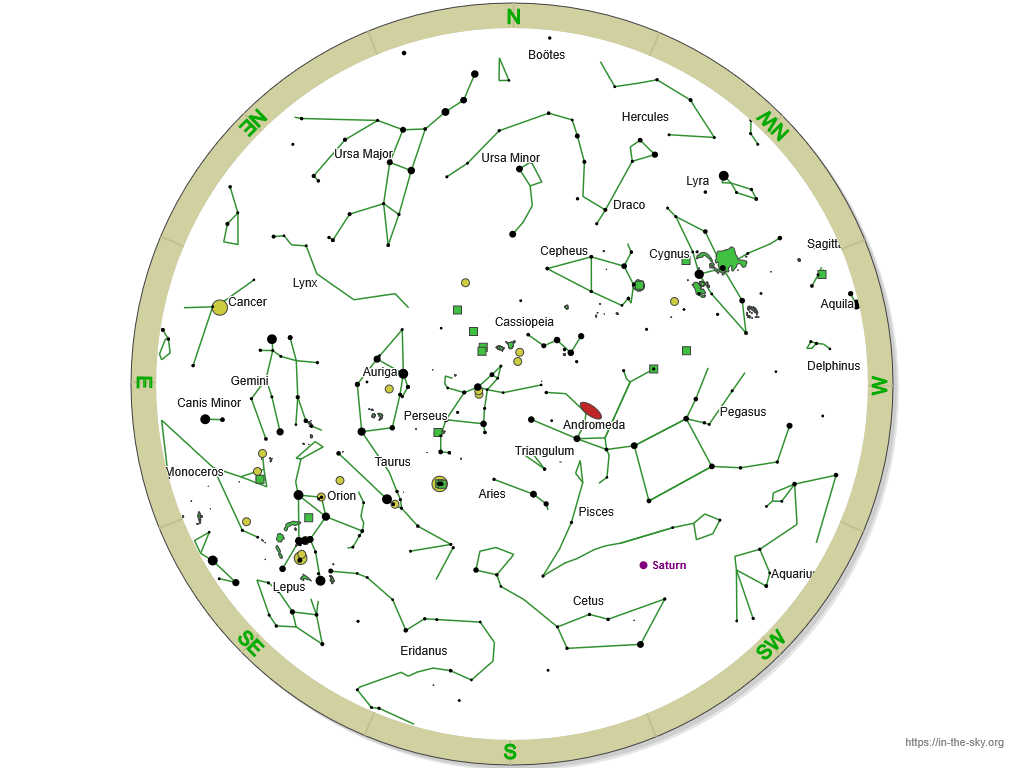
An all-sky view of the constellations from 22:00 on 1st December from in-the-sky.org – this is a printable map – click or tap the image to download the PDF.
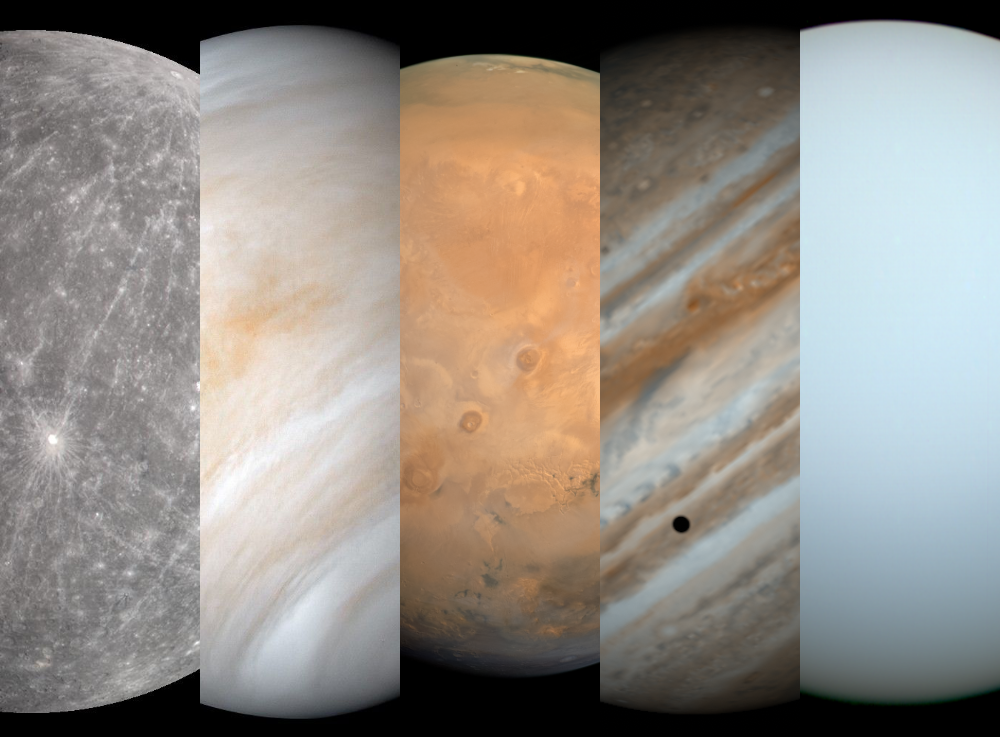
The Planets in December
Mercury can be seen for the first two weeks of the month as it rises in the east before dawn at 06:35 at the beginning of the month but quickly loses altitude and is lost in the morning glare from the middle of the month onwards.
Venus consistently rises at around 04:00 throughout December and will appear as a very bright morning star.
Mars rises at 22:40 at the start of the month and at 21:30 at the end.
Jupiter rises at around 22:00 at the start of the month and at 20:30 at the end.
Saturn will be well placed in the constellation of Pisces as darkness falls.
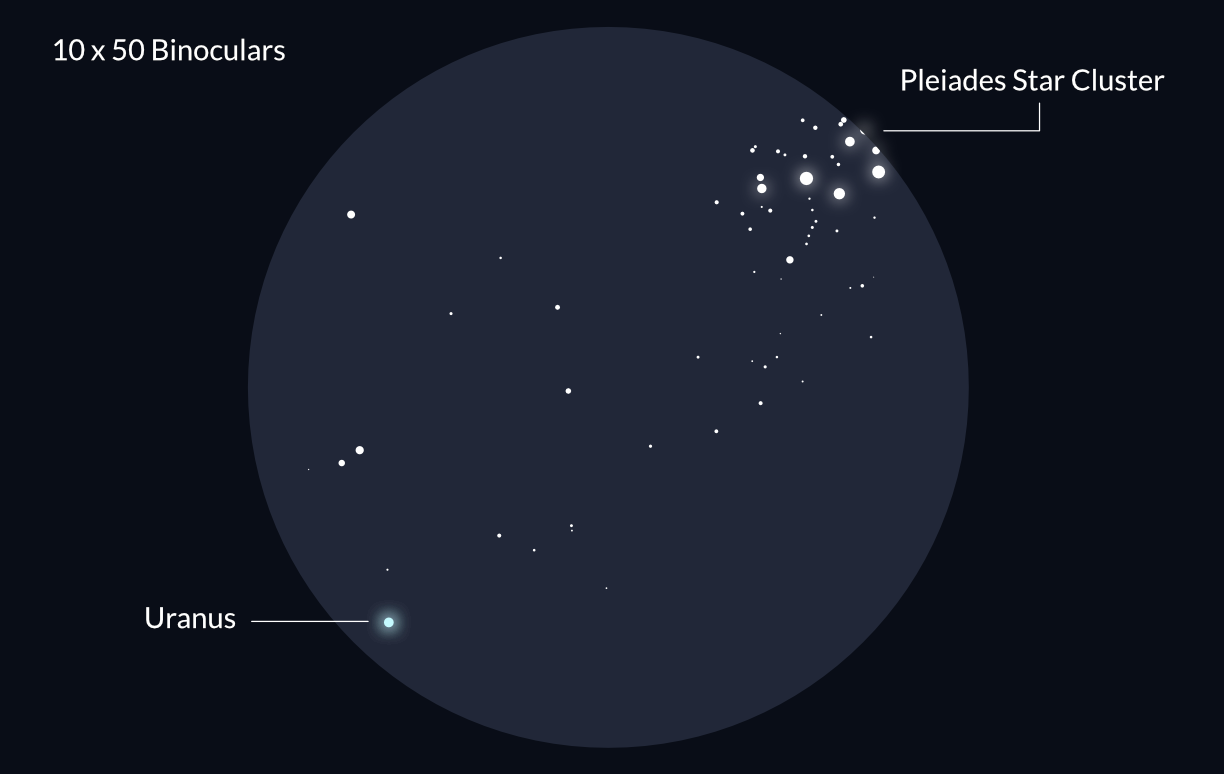
Uranus remains in the constellation of Taurus and can be spotted with binoculars. Find the Pleiades Star Cluster and place it near the top of the field of view. Uranus will appear near the bottom edge as a steady, faint blue-green star.
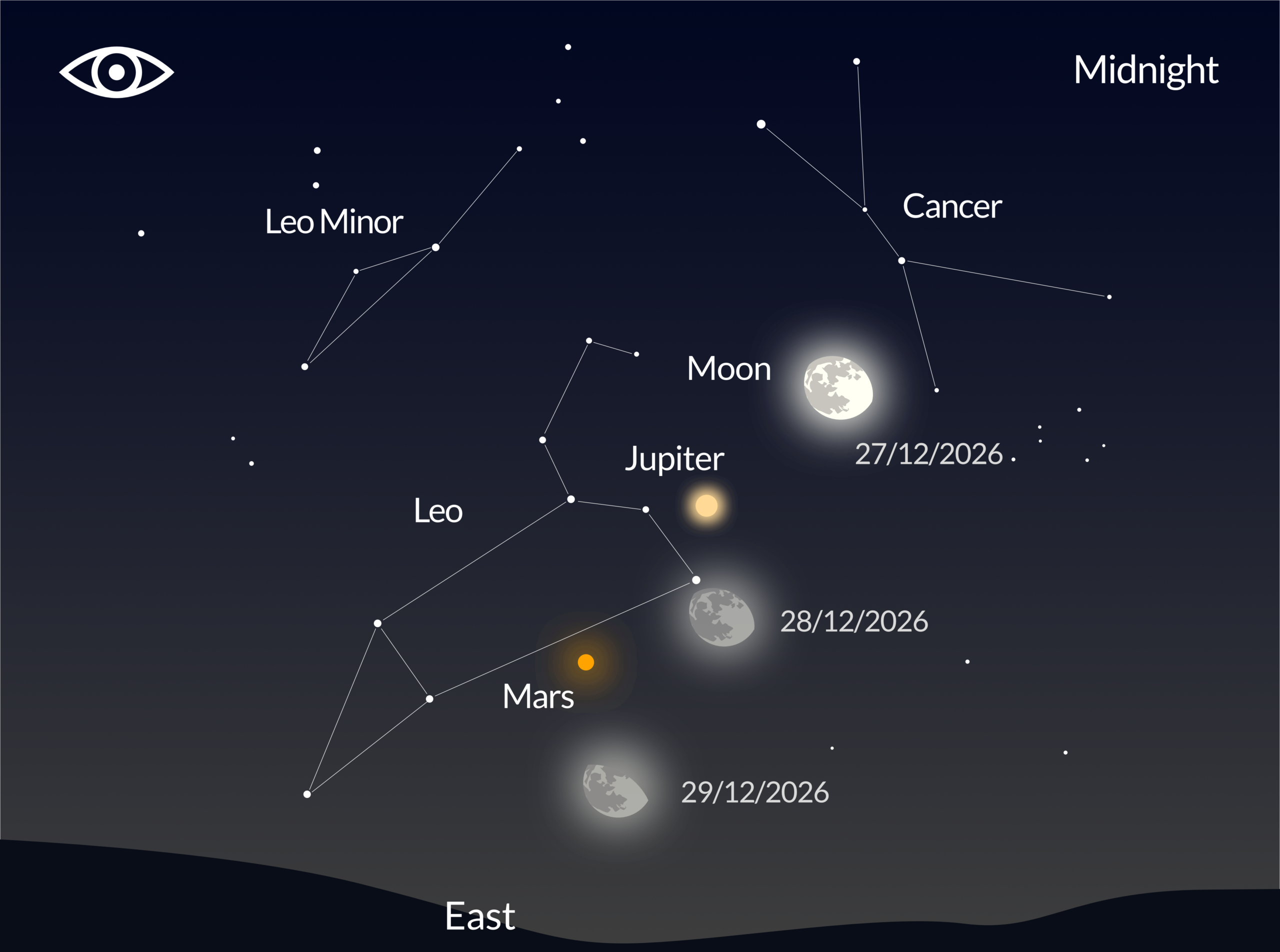
Between 27th to 29th December, there will be a close trio of solar system objects as the gibbous Moon lies near Mars and Jupiter. Look to the eastern sky towards midnight.
Geminid Meteor Shower
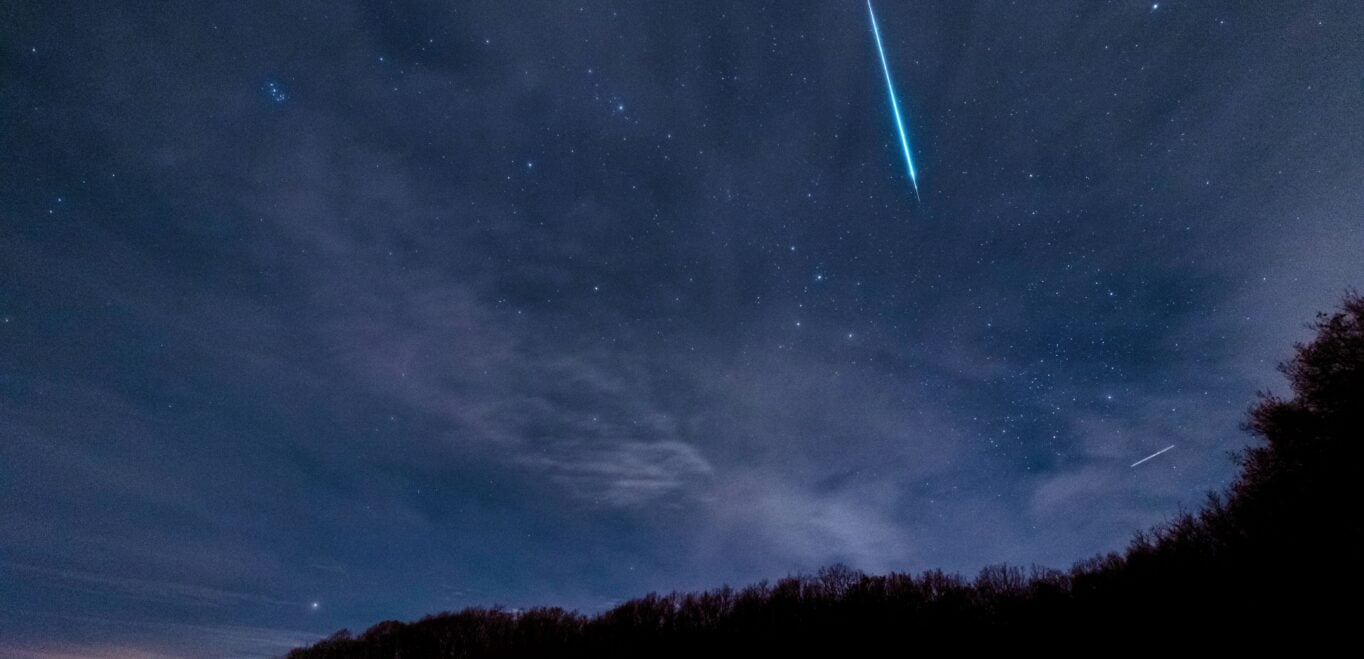
The Geminid Meteor Shower will be active from 4th – 20th December, peaking on the night of 13th December to the early morning of 14th December.
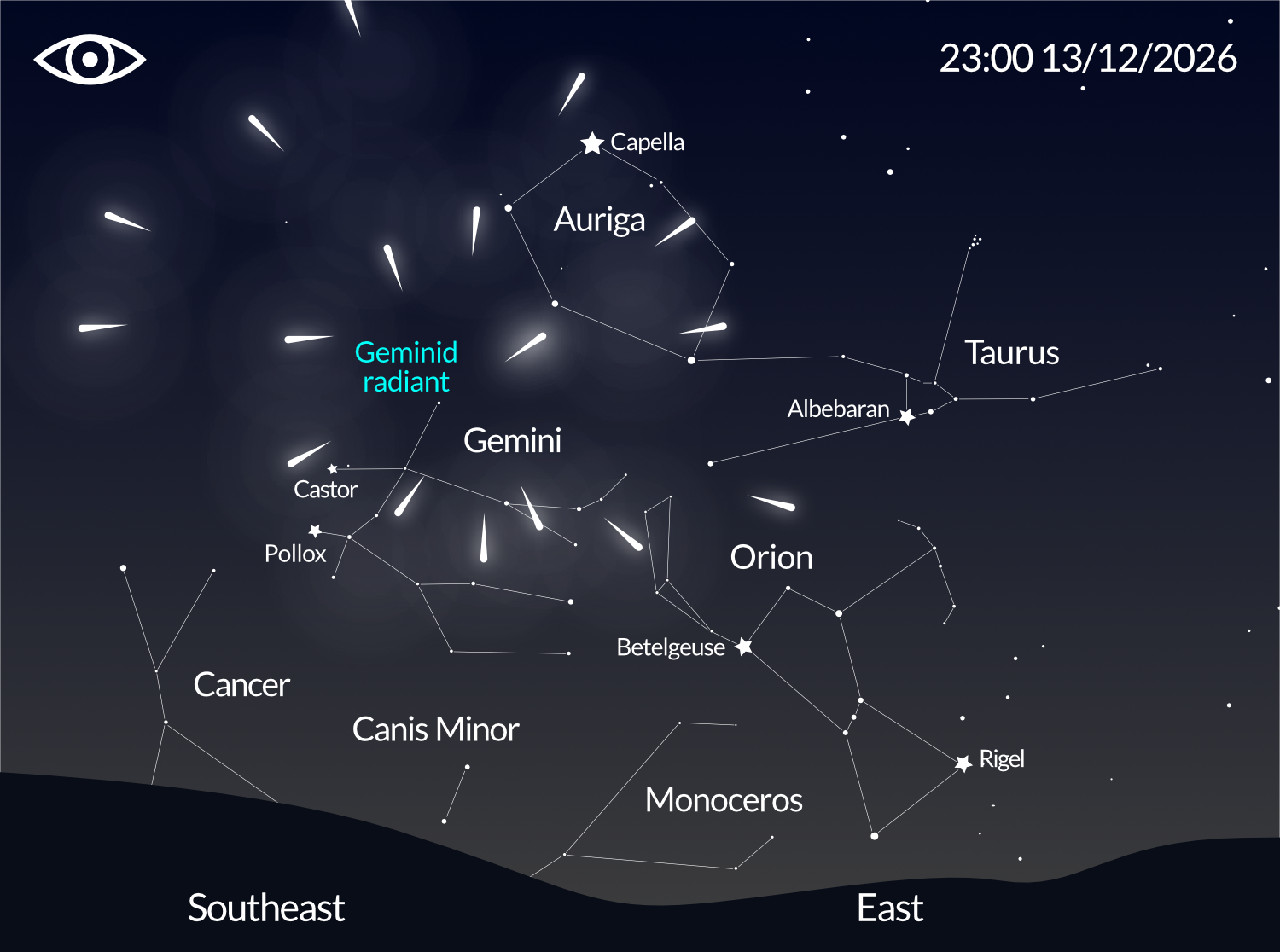
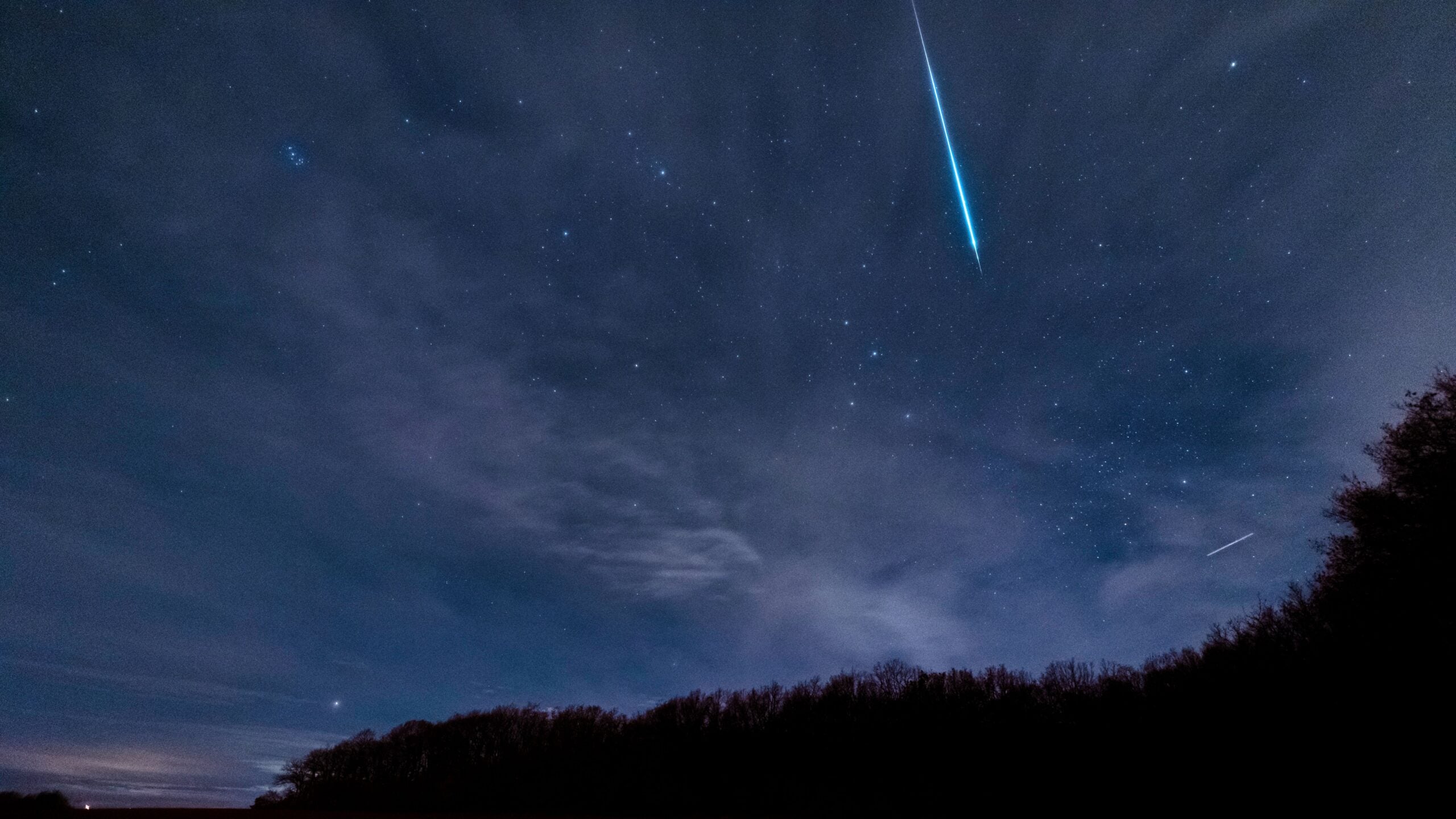
As the Earth passes through the debris of asteroid 3200 Phaethon, this pre-Christmas show will include bright, multicoloured shooting stars and the occasional fireball. It’s the second most prolific meteor shower of the year, producing up to 120 meteors per hour. The Moon will set at 20:13, providing a dark night to see this show at its best.
Image credit: Roy S.
Deep Sky Delights
Discover this month’s top deep-sky targets for telescopes, binoculars, and the naked eye.
Plus, check out our new feature, where we will select the best deep-sky treasure to capture with your smart telescope.

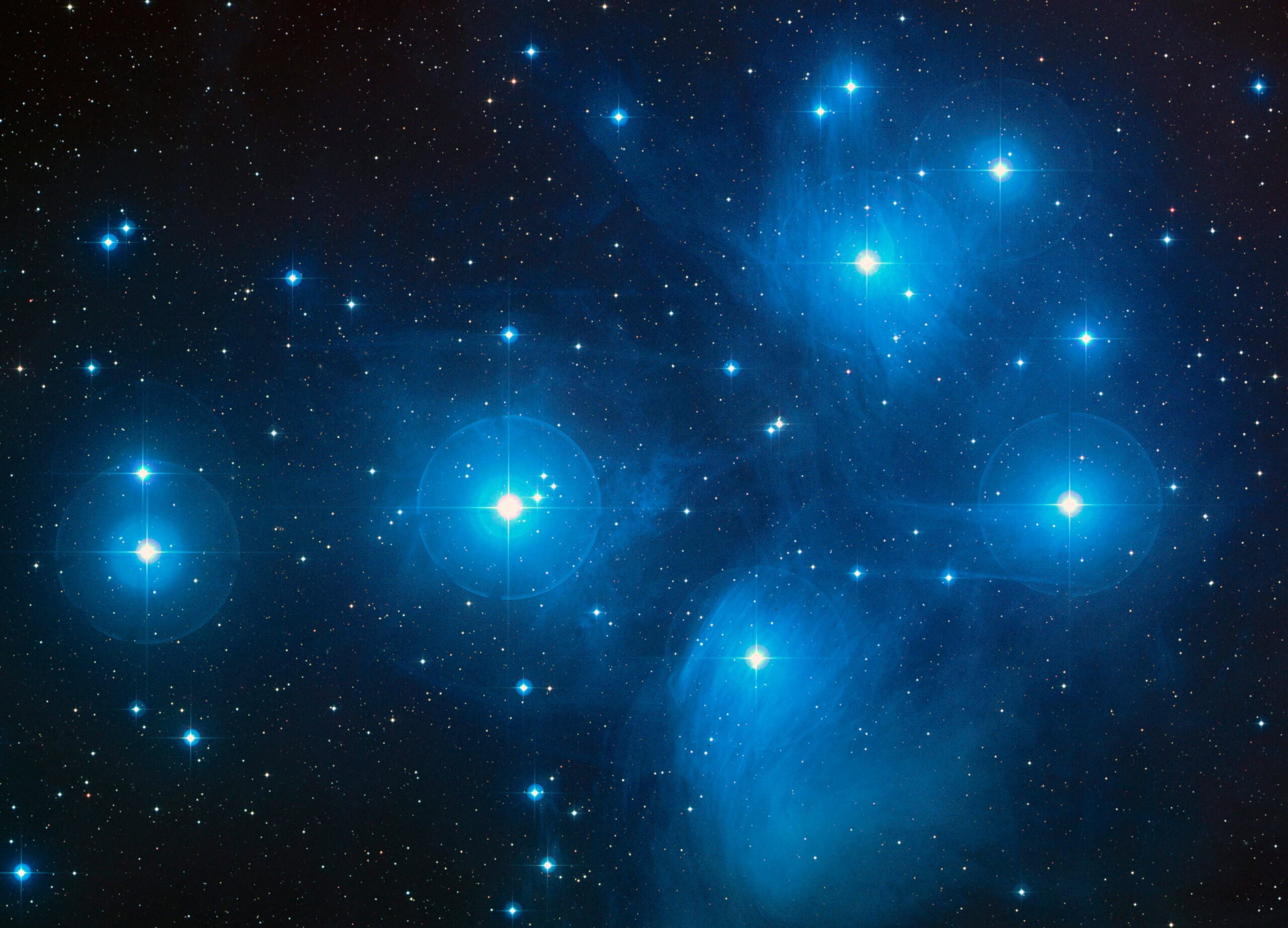
Pleiades Star Cluster
Even though this prominent star cluster has been a feature of the night sky throughout autumn, this unaided-eye object is well-placed in the December sky as darkness falls. It is also an easy target for binoculars.
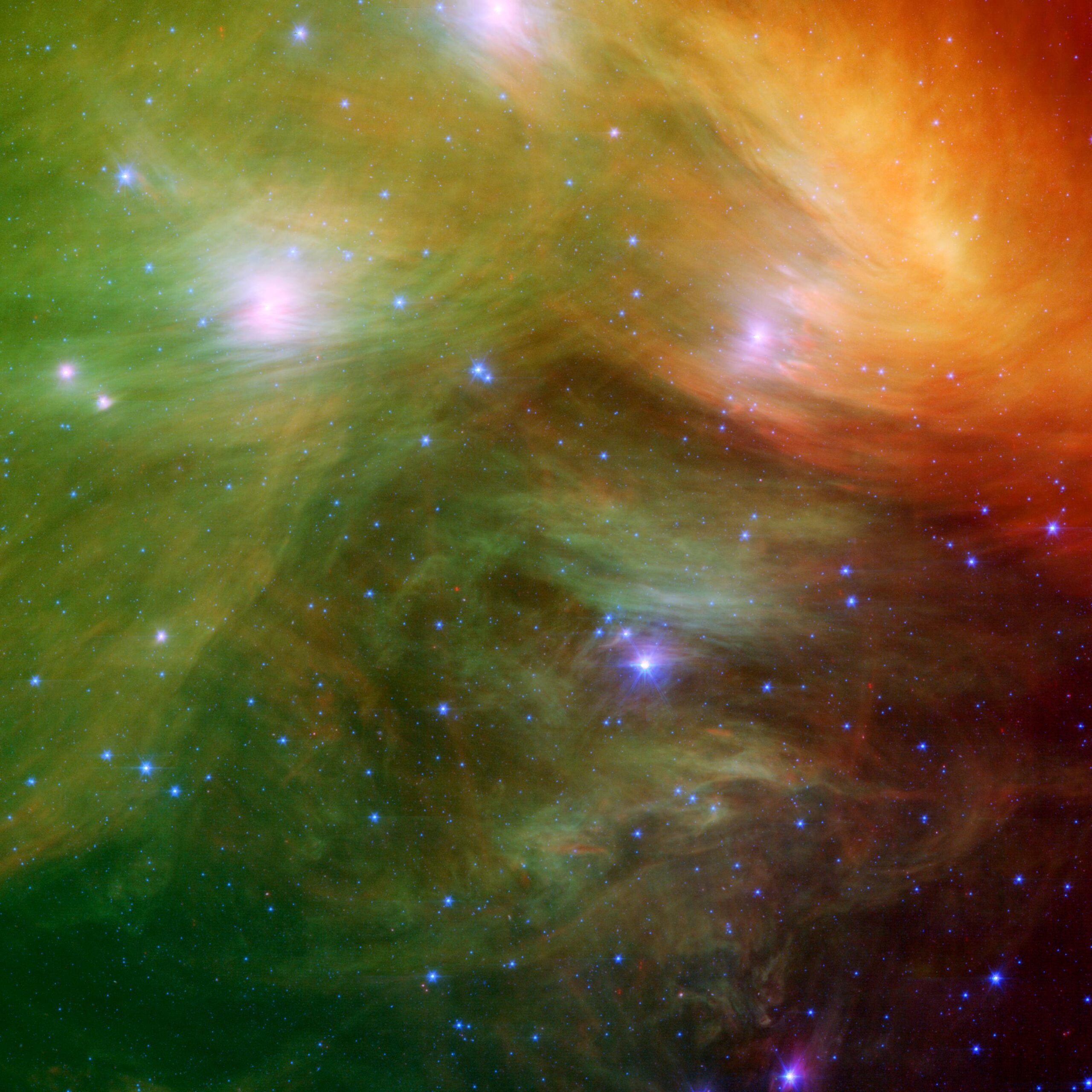
Image: By NASA, ESA, AURA/Caltech, Palomar Observatory
Public Domain
Positioned above and to the west of the constellation of Orion, this bright star cluster, situated 444 light years away, contains 1,000 young and hot stars – six or seven of these can be seen with the unaided eye.
It is situated just above the arrow asterism of the constellation of Taurus.
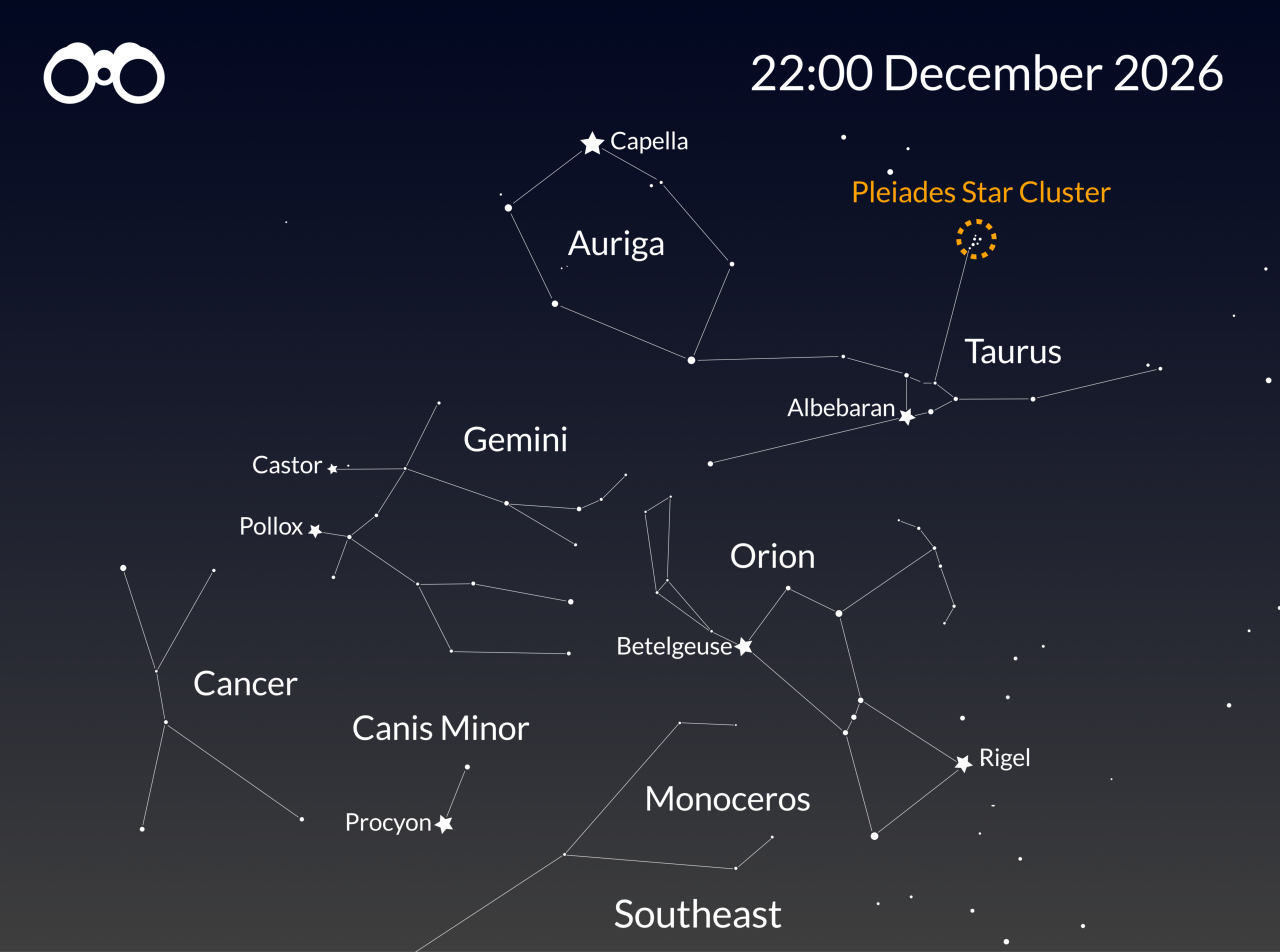
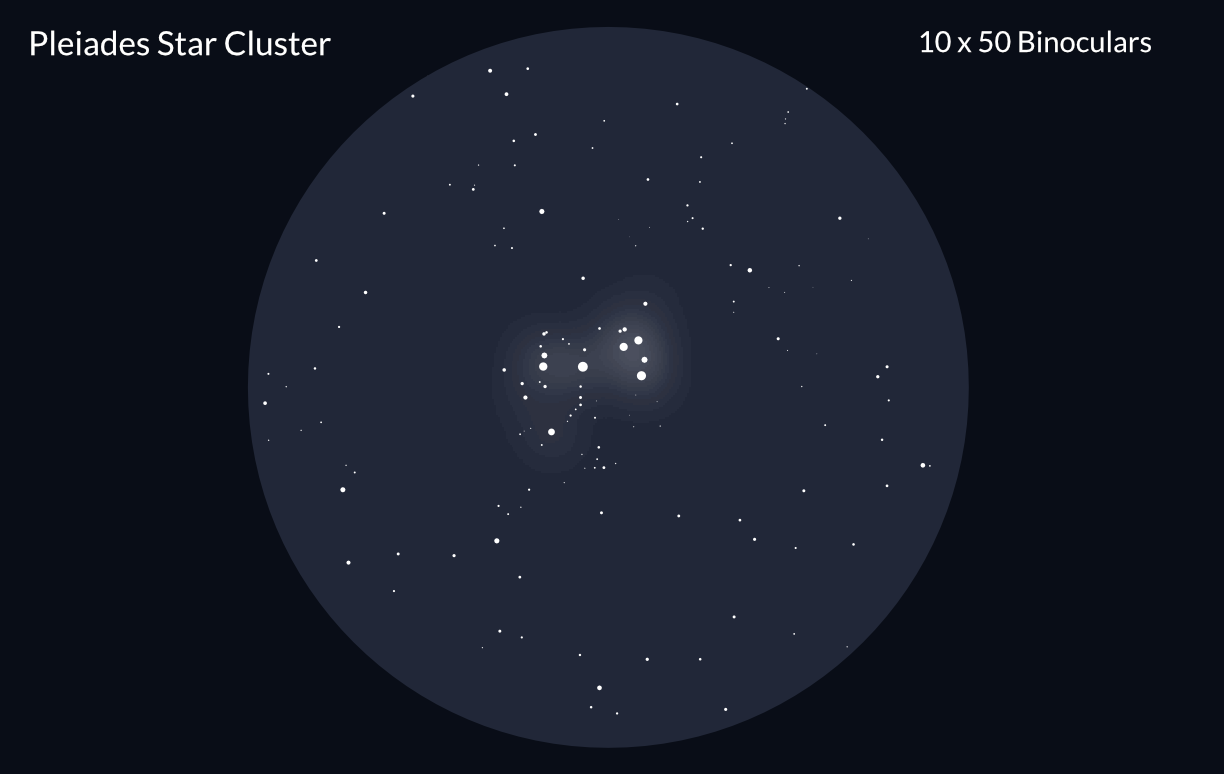
Raise the binoculars to your eyes to spot the shimmering collection of stars – in a dark sky, these might even show a slight hint of nebulosity. Amongst the brighter stars lies a curving star chain.
This cluster is recognised all over the world, known as Subaru (which means ‘unite’) in Japan and Matariki in New Zealand. Matariki is short for Ngā Mata o te Ariki Tāwhirimātea (“The eyes of the god Tāwhirimātea”). According to legend, the wind god tore out his eyes and cast them into the sky in anger when his parents were separated. In Greek mythology, the Pleiades Star Cluster is also known as the Seven Sisters, representing the seven daughters of Atlas and the nymph Pleione, whom Zeus saved from the relentless pursuit of the great hunter Orion by placing them in the stars.
Image: NASA/JPL-Caltech

A Jewel in the Crown of Winter
RA: 05h 35m 16.8s | DEC: −05° 23′ 15″
The Orion Nebula is always a showstopper during the winter months, due to its impressive structure appearing in even modest visual telescopes.
This incredible object can also be seen with the unaided eye on a dark night.
Situated in the constellation of Orion, this stellar nursery lies 1,500 light years away from us.
Image: By NASA, ESA, M. Robberto (Space Telescope Science Institute/ESA) and the Hubble Space Telescope Orion Treasury Project Team
Public Domain
You can find it by looking for the hourglass shape and the three-star belt above the southern horizon. Within the belt hangs a celestial glittering sword, where the Orion Nebula is located. To the unaided eye, it resembles a bloated star, but through telescopes, the nebula blooms into a white cosmic orchid, with the stars resembling stamens in the centre. Those stars comprise the Trapezium asterism. Under dark skies through larger telescopes with an aperture of ten inches or more, a slight hint of colour may be seen.
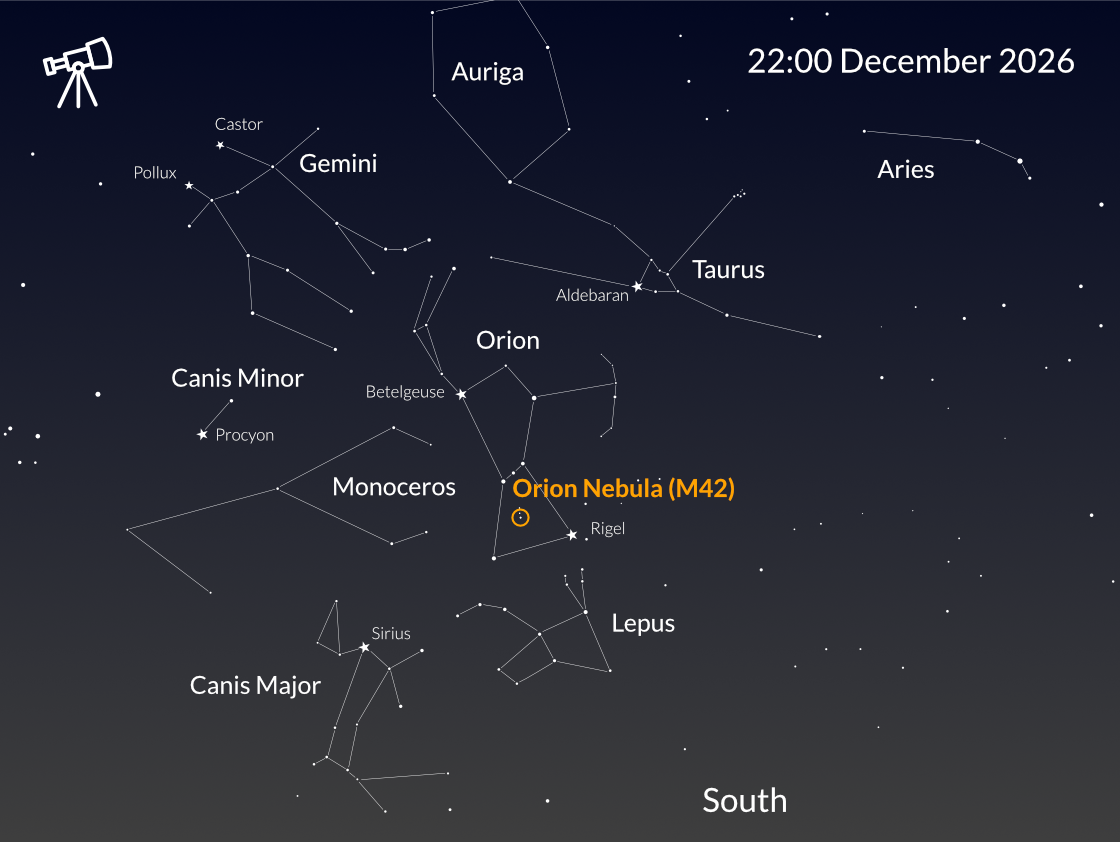
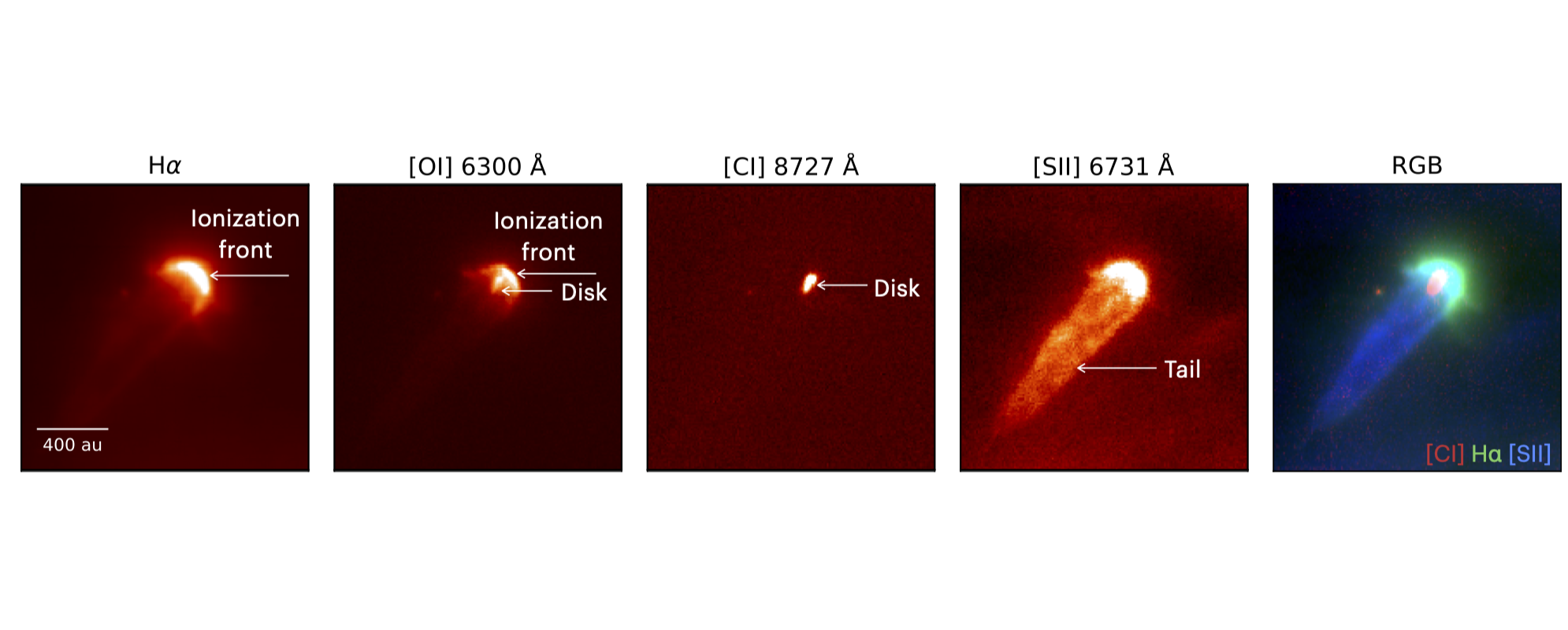
Lit by the ultraviolet light of young stars, the nebula contains around 3,000 young stars, brown dwarfs and even protoplanetary discs where new planets may form.
Image credit: Mlaru, CC BY-SA 4.0, via Wikimedia Commons
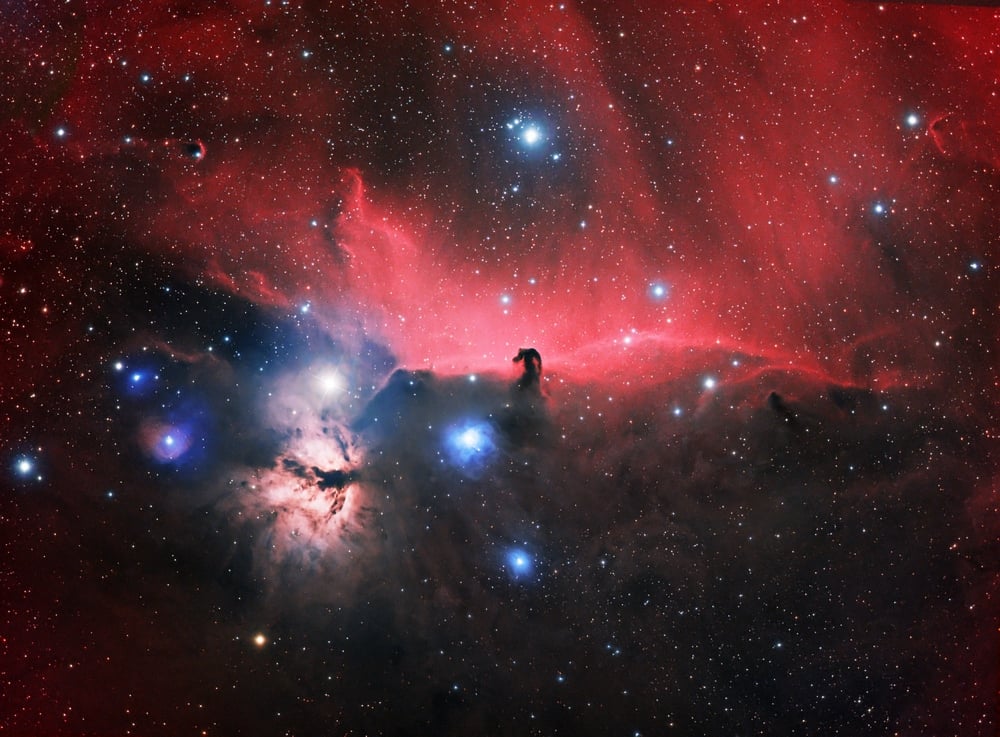
Two Nebulae for the Price of One
For those with a smart telescope, there are two impressive star-forming nebulae which are worth capturing and look wonderful in wide field or imaged separately.
The Horsehead (Barnard 33) and Flame Nebulae (NGC 2024) are neighbouring star-forming regions situated in the constellation of Orion. They are situated around the star Alnitak, which is the bright blue star in the centre of the image.
By Stephanh – Own work, CC BY-SA 4.0
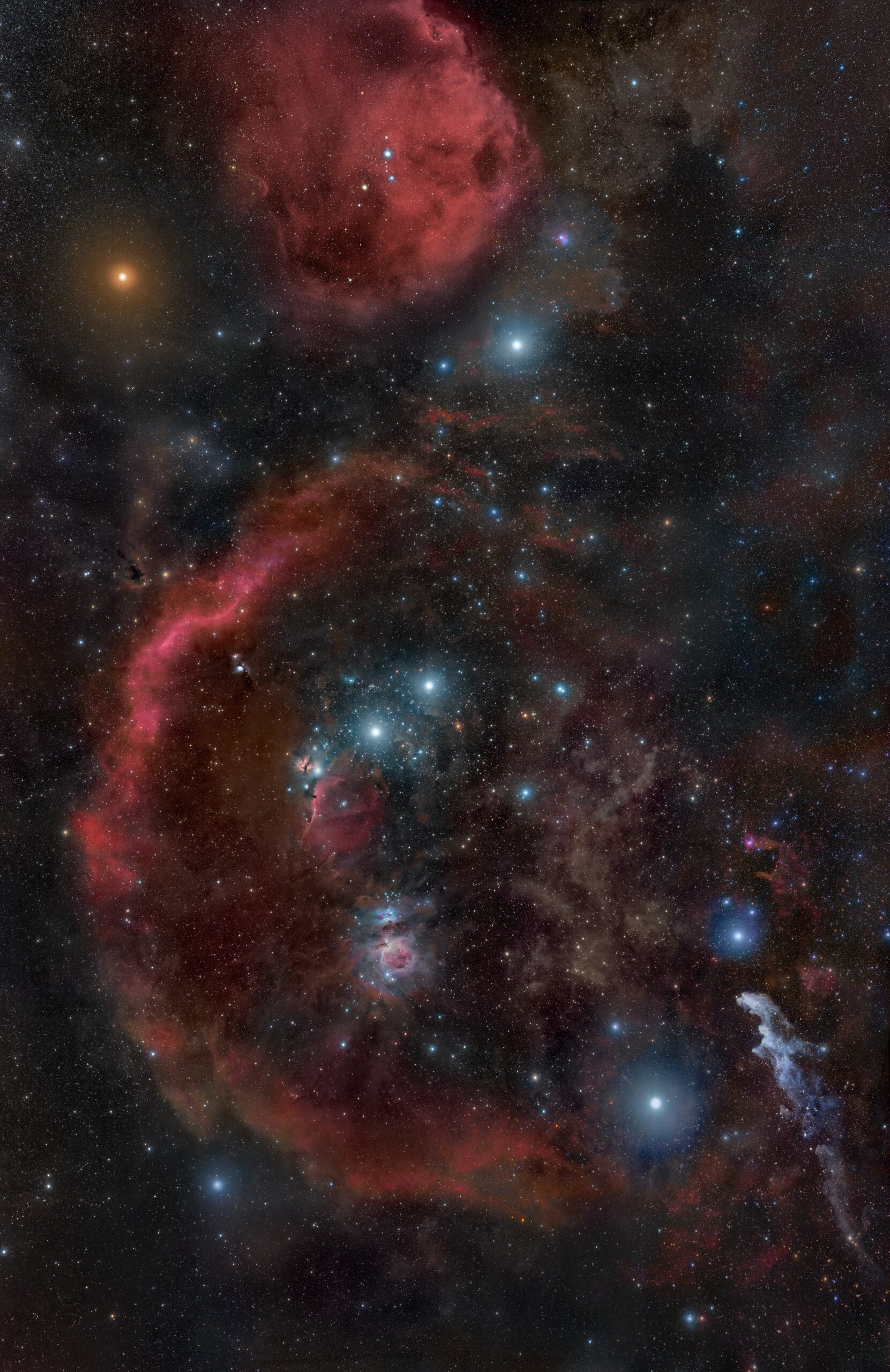
The Flame Nebula is a bright emission nebula, lit by the ultraviolet radiation from the star IRS 2b, with an area of dark dust intersecting the core, enabling the nebula to resemble a flame.
The Horsehead Nebula’s background is lit by the star system Sigma Orionis, with the Horsehead being sculpted by dense dust and cold molecular gas.
They are both star-forming regions, filled with dense pockets of gas and dust, within the immense Orion B molecular cloud. This material is compressed by gravity, collapsing and creating new stars.
Image: The Orion B Molecular Cloud
By Rogelio Bernal Andreo , CC BY-SA 3.0
Hints and Tips
The darker the sky, the better:
Find a dark sky area, away from light pollution, and choose a moonless night.
Use equatorial (EQ) mode:
Your unit has alt-azimuth mode, which is sufficient for brighter targets and also an equatorial mode option. Equatorial mode is better for longer exposures, as the tracking follows the arc-type movement of the stars due to the Earth’s rotation.
Mosaic mode:
Your telescope may not have a wide enough lens to capture both nebulae in one image, so many exposures may have to be taken as your telescope moves across the target area, capturing frames and stitching together the images like tiles to form one wide-field photograph. You can use ‘Mosaic Mode’ to capture these cosmic neighbours together if desired.
Be patient:
Try to get several hours of exposure time – set your unit to take 20-30 second exposures.
Want to bring out more details in your image?
Your unit should be able to process and stack these images, but if you save your raw data (where the telescope saves all the individual exposures, instead of stacking them into one image file), there is good, open-source software available such as GraXpert and Siril if you wish to process the final image further.