Welcome to this month’s update to find out what’s in the night sky for August.
In the Elan Valley International Dark Sky Park, astronomical darkness returns for 20 minutes returns on 8th August between 23:37 and midnight. From here on in, astronomical darkness increases throughout the month.
The New Moon falls on 12th August and the Full ‘Sturgeon’ Moon on 28th August.
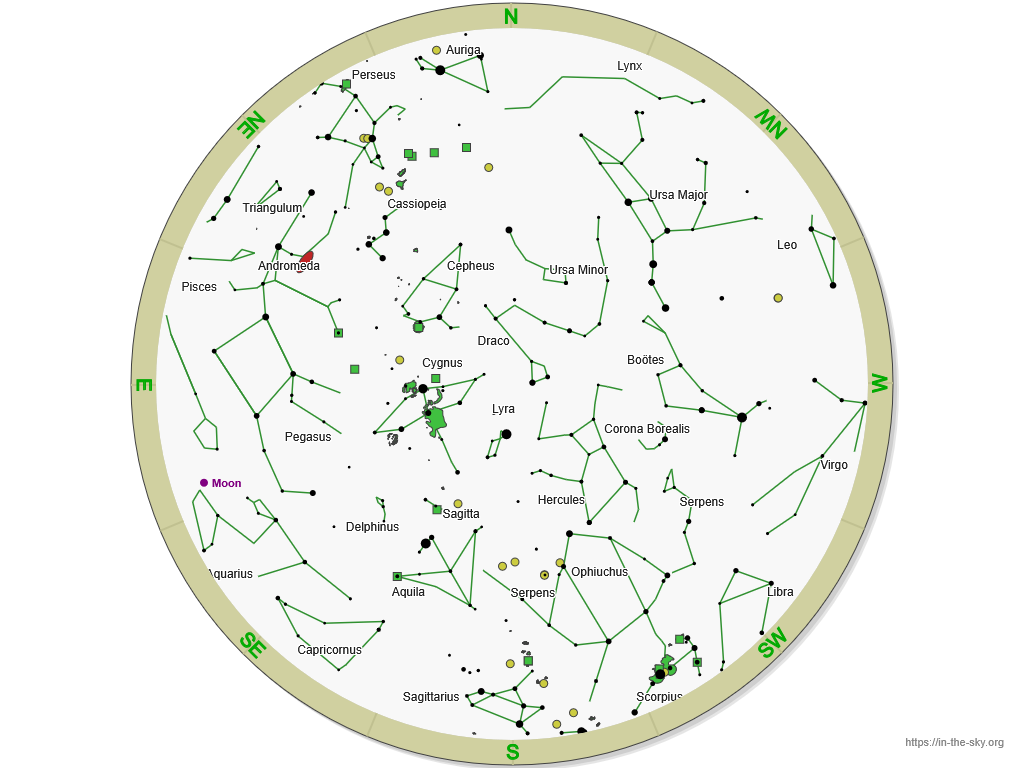
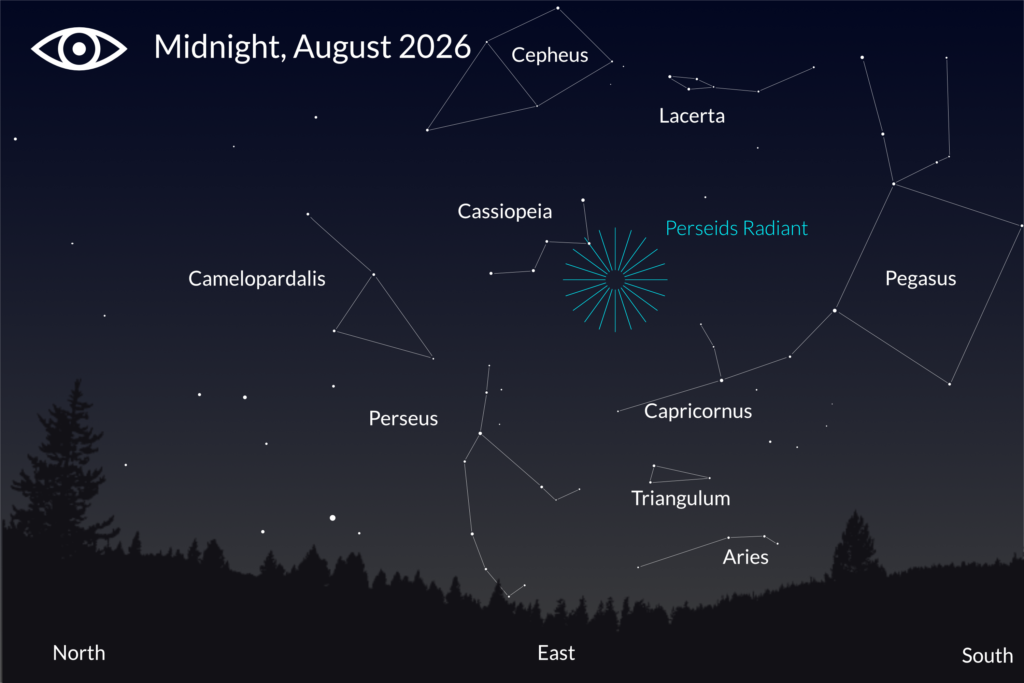
An all-sky view of the constellations from midnight on 1st August from in-the-sky.org – this is a printable map – click tap the image to download the pdf
To learn about the constellations, you can tap the image above which will download as a printable PDF.
Constellation of the Month – Sagittarius
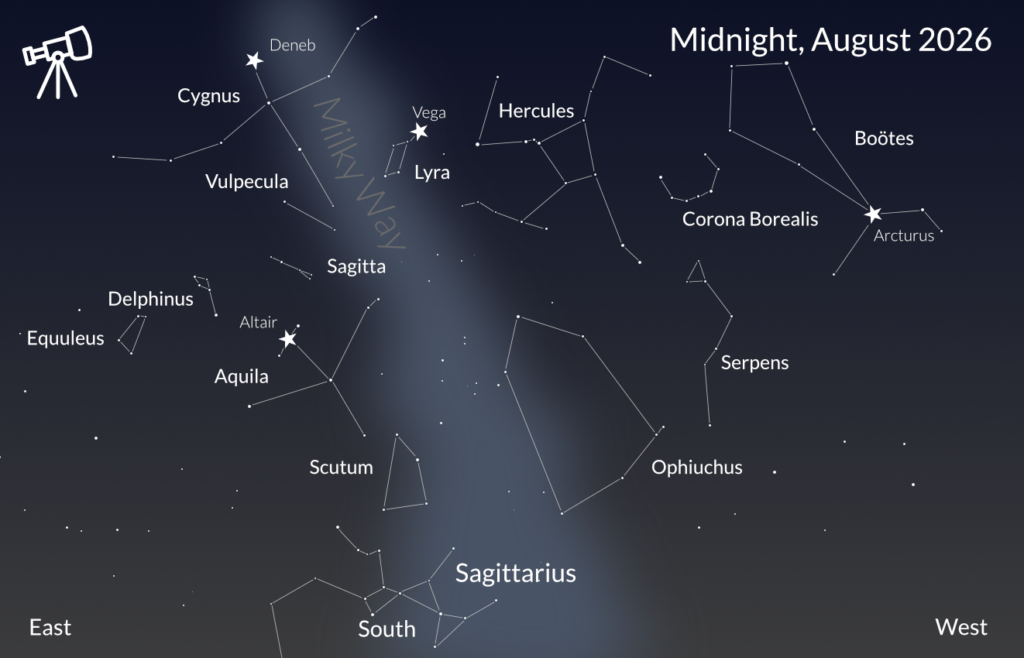
Sagittarius appears as a teapot-shaped asterism. The “Teapot” is famous as a recognisable star pattern within the larger constellation of Sagittarius. Its eight brightest stars perfectly trace the outline of an earthly teapot, complete with a handle, lid, body, and spout (the handle is on the left-hand side, and the spout is on the right). This celestial vessel contains many deep sky treasures which we will cover in this month’s update.
Image: Johann Elert Bode – Sagittarius and Sobieski’s Shield
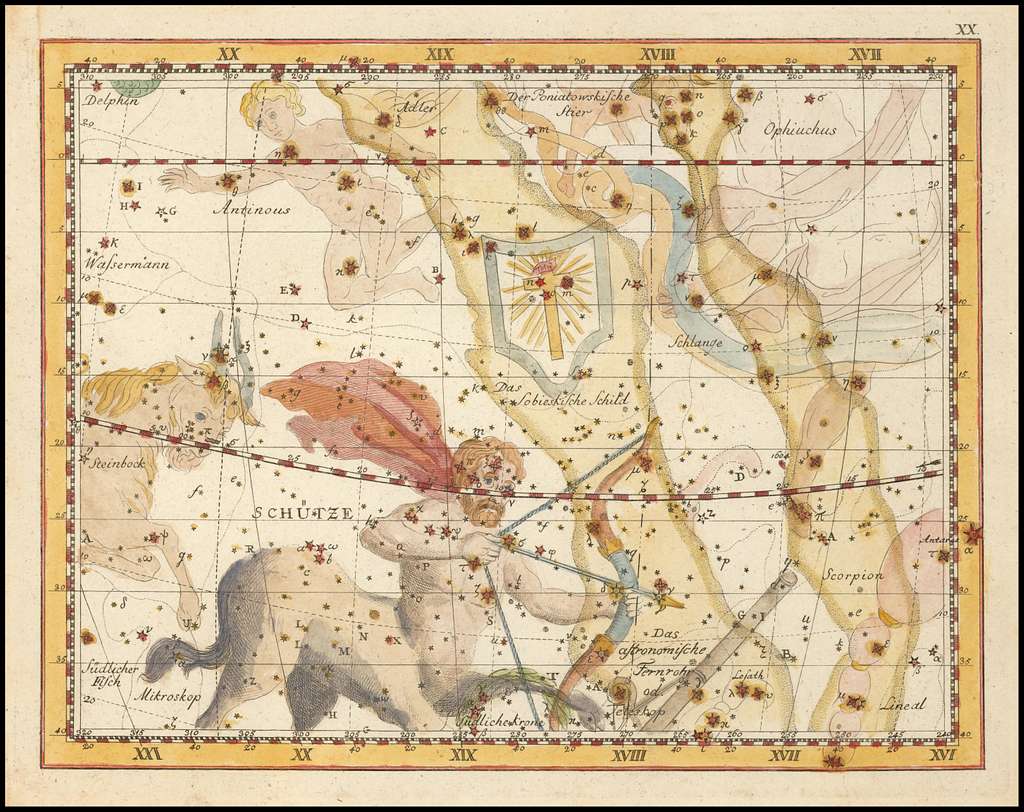
This constellation harks back to ancient times, where the Sumerians place Sagittarius as Pabilsag, the fierce god of war and hunting, who was also a skilled archer. Depicted initially as a winged half horse-half man, his name means ‘Chief Ancestor’ or ‘Forefather’.
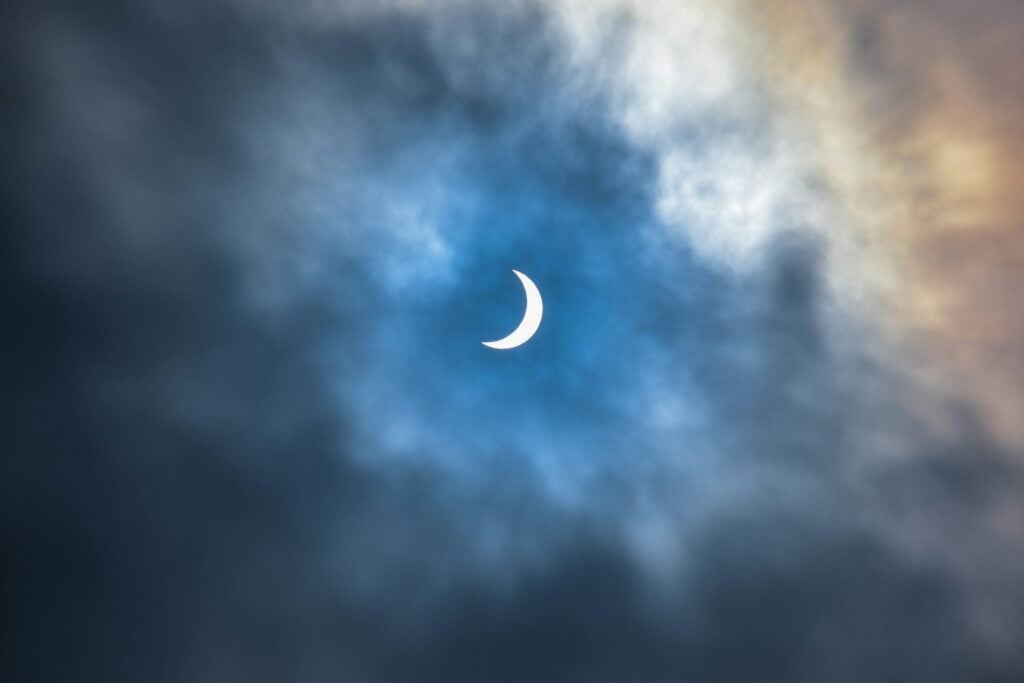
Double Spectacle
Partial Solar Eclipse – 12th August
There will be a deep partial solar eclipse occurring on this date, which coincides with the peak of the largest meteor shower in the year. Having two significant astronomical events of this type occurring on the same day is extremely rare and will never occur again. The late afternoon show begins at 6:15pm as the Moon passes in front of the Sun. Skywatchers in Mid Wales will see one of the deepest eclipses in the UK, with 94% of the Sun obscured by the Moon at 7:12pm, before the Moon leaves the face of the Sun at 8:06pm.
Perseid Meteor Shower – 17th July-24th August – Peaks 12th August
As darkness falls, look to the night skies as the Perseid Meteor shower peaks. At first, a few can be spotted as the night deepens, but as midnight approaches, the number of shooting stars will dramatically increase. There will be around 150 meteors per hour during this peak and may appear as bright and fast meteors with even smoking trails.
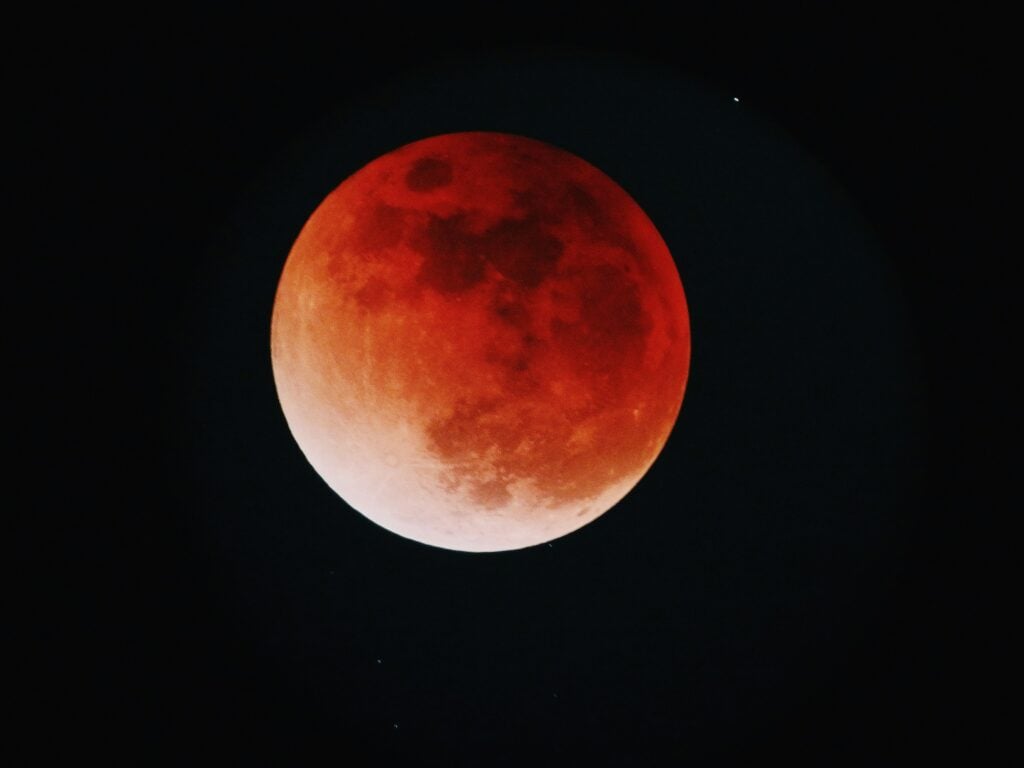
And a Partial Lunar Eclipse!
On 28th August, in the early hours, there will be a deep partial Lunar Eclipse. This will be an opportunity to see an almost blood red Moon. Early risers will see the penumbra (Where the Earth’s shadow begins to touch the Moon) at 2.23am, with the partial eclipse starting at 3.33 and peaking at 5.12am, where 93% of the Earth’s shadow covers the Moon. As the day dawns, it will be too light to see the rest of the eclipse.
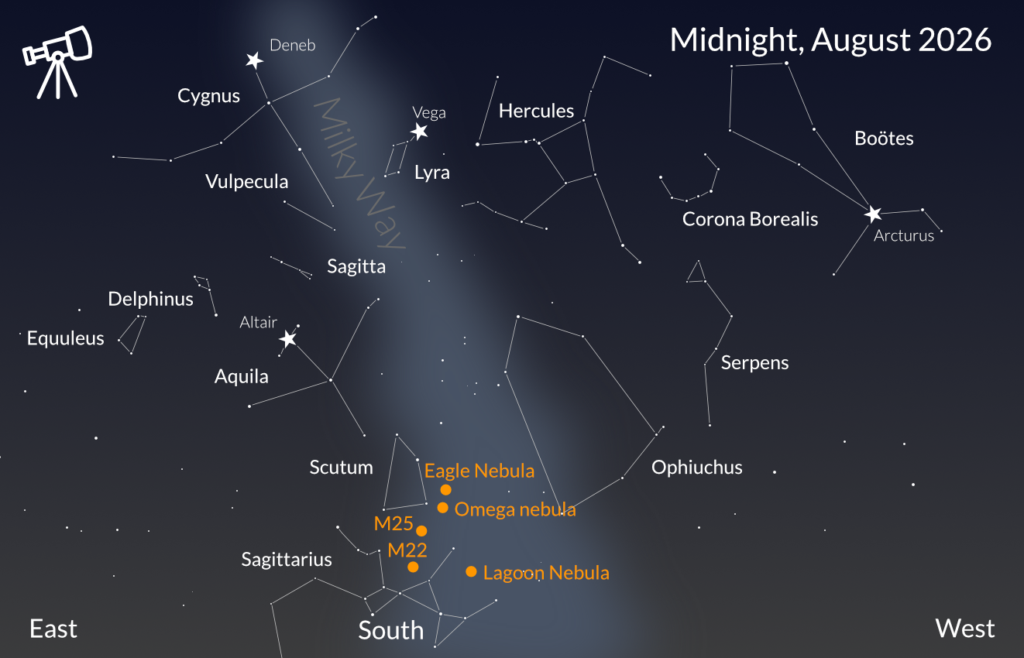
Top Five Deep Sky Objects
We select our top five deep sky objects in the night sky for August. You will need a low horizon and dark skies to study them, as these objects lie in the constellation of Sagittarius.
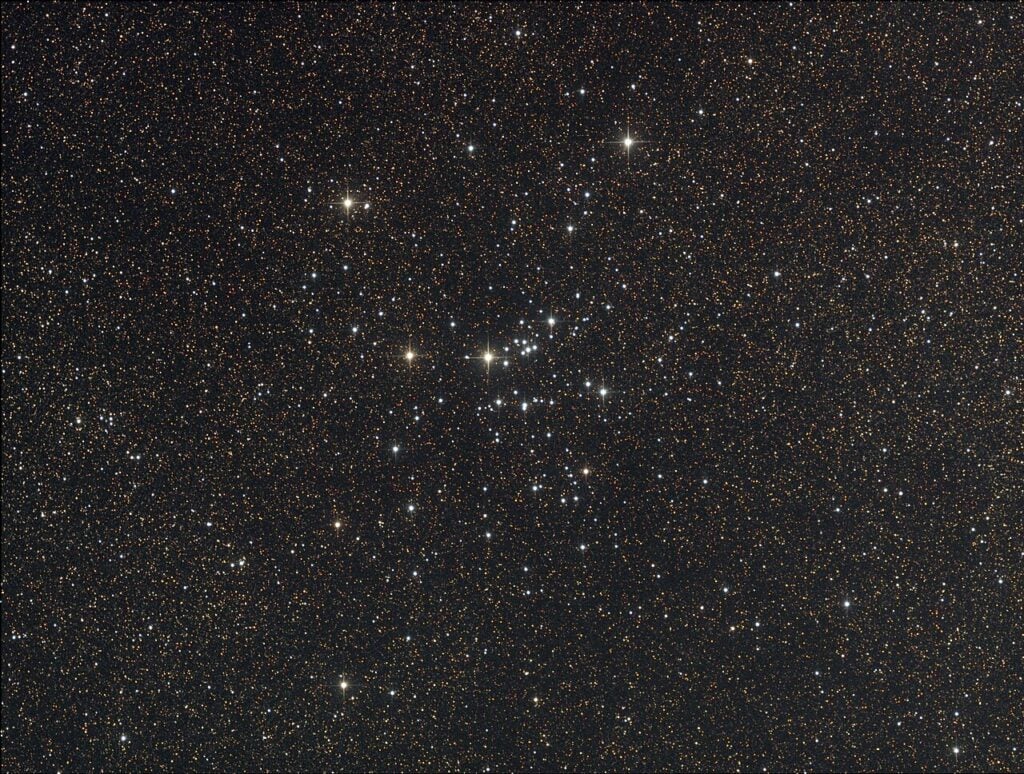
5: Messier 25
Coordinates: RA 18h 31m 47.0s | Dec −19° 07′ 00″
Type: Open Star Cluster
Also known as: IC 4725
Distance: 2,000 light years
Facts: It contains a Delta Cephei-type variable star called U Sagittarii. It brightens and darkens over around 7 days, which has helped scientists use a frame of reference for measuring distances in space.
Appearance: Appears as a loose collection of 30 stars though a 4-inch telescope. Through a 12-inch telescope, up to 80 stars can be seen through a wide field eye piece.
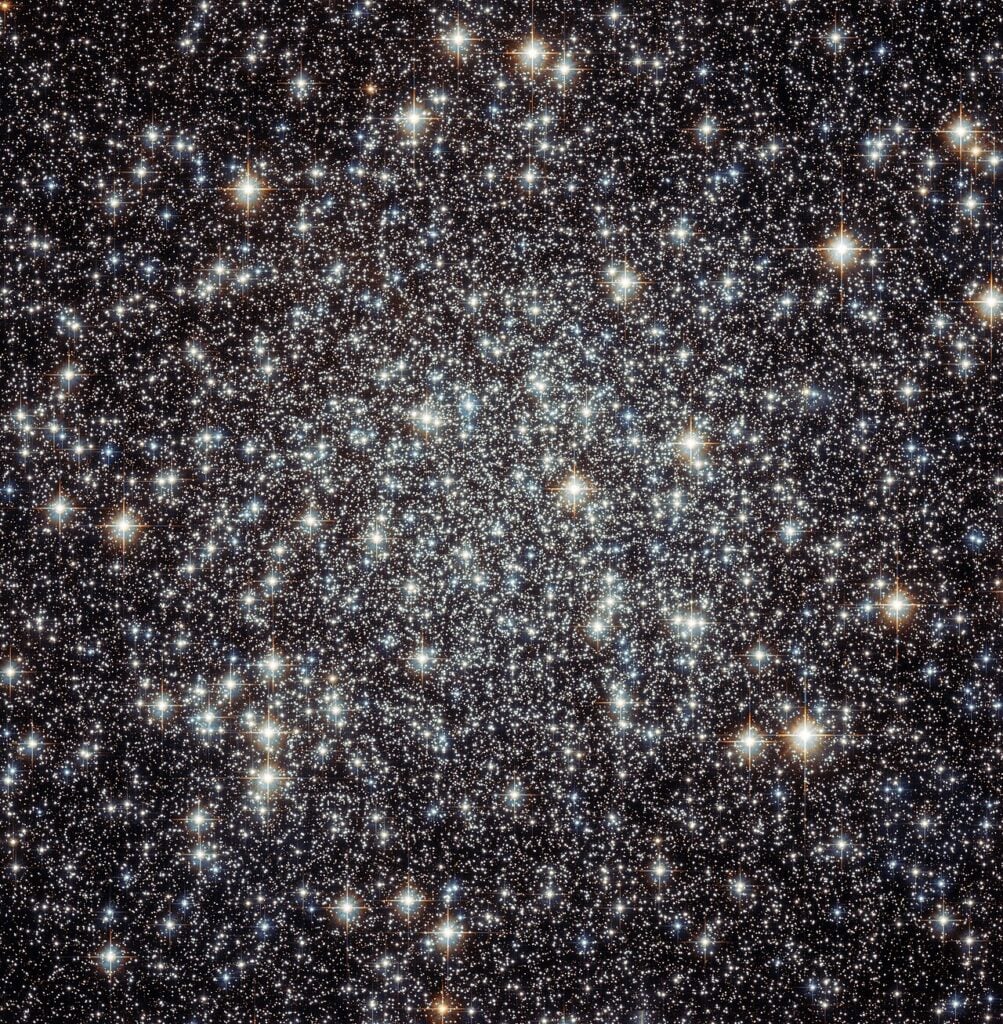
4: Messier 22
Coordinates: RA: 18h 36m 24s | Dec: -23° 54′ 17.1″
Type: Globular Cluster
Also known as: NGC 6656, the Great Sagittarius Cluster
Distance: 10,600 light years
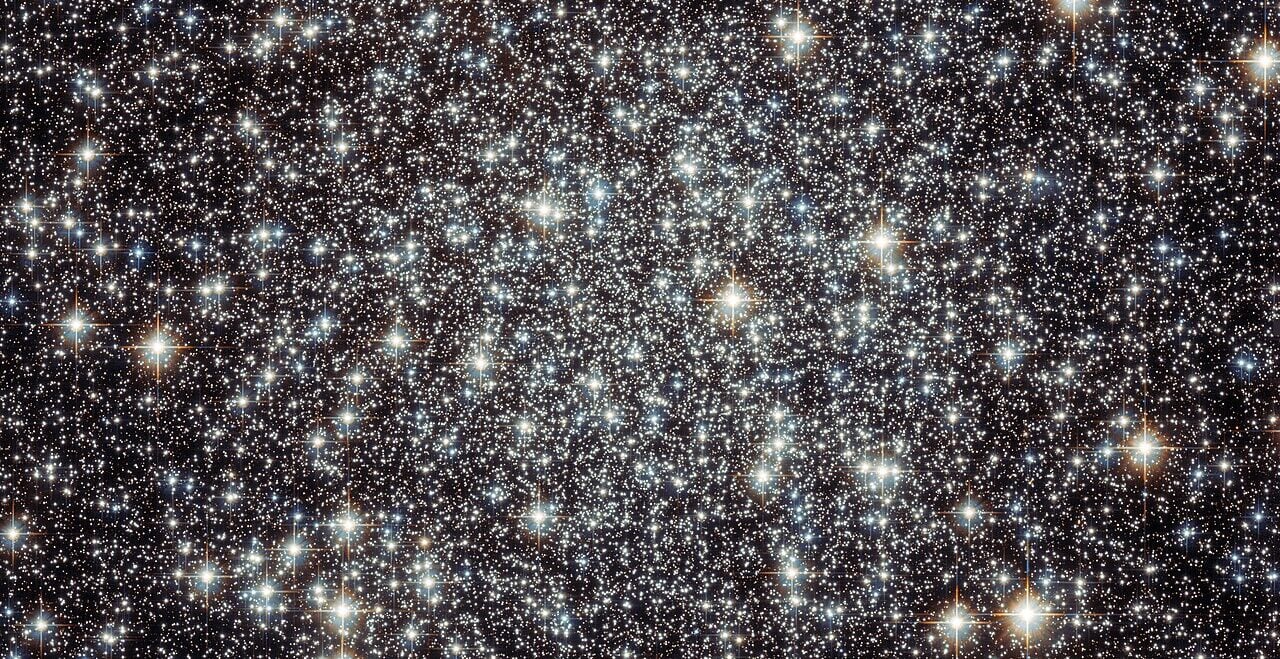
Facts: Contains 100,000 to 300,000 stars. Globular clusters are situated on the outer edges of a galaxy and are thought to be the oldest objects in the universe. The largest globular cluster in the Milky Way is Omega Centauri, containing 10 million stars!
Appearance: Through a 4-inch telescope, the outer stars will be resolved, with a fuzzy core. Through a 12-inch telescope, stars can be resolved to the core.
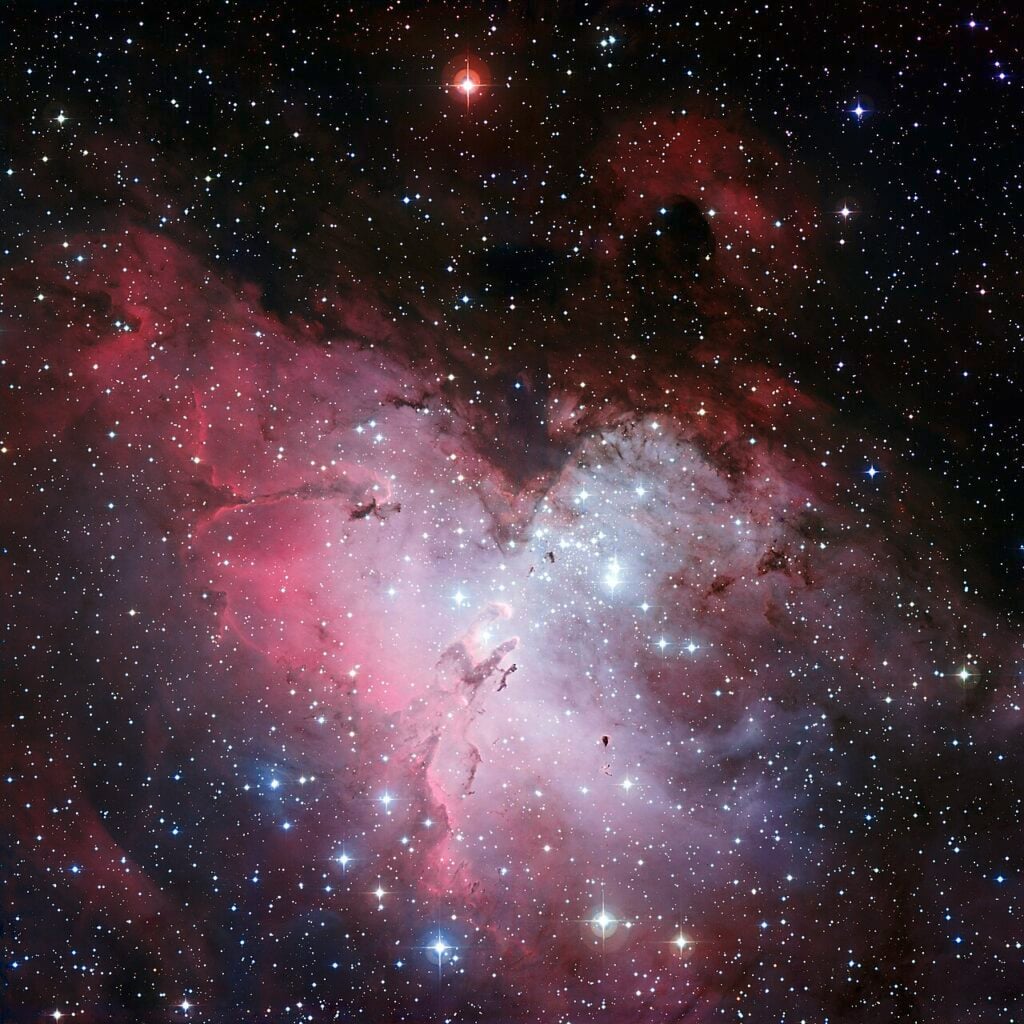
3: Eagle Nebula
Coordinates: RA: 18h 18m 48s | Dec: -13° 49′ 00
Type: Emission Nebula and Open Star Cluster
Also known as: Messier 16, Star Queen Nebula
Distance: 7000 light years
Facts: Contains the famous Pillars of Creation.
Young star forming region containing over 8000 stars.
Appearance: Through 4-inch telescopes, the star cluster can be seen. Through 12-inch telescopes, a UHC or OIII filter and dark skies, observers will tease out nebulaic detail.
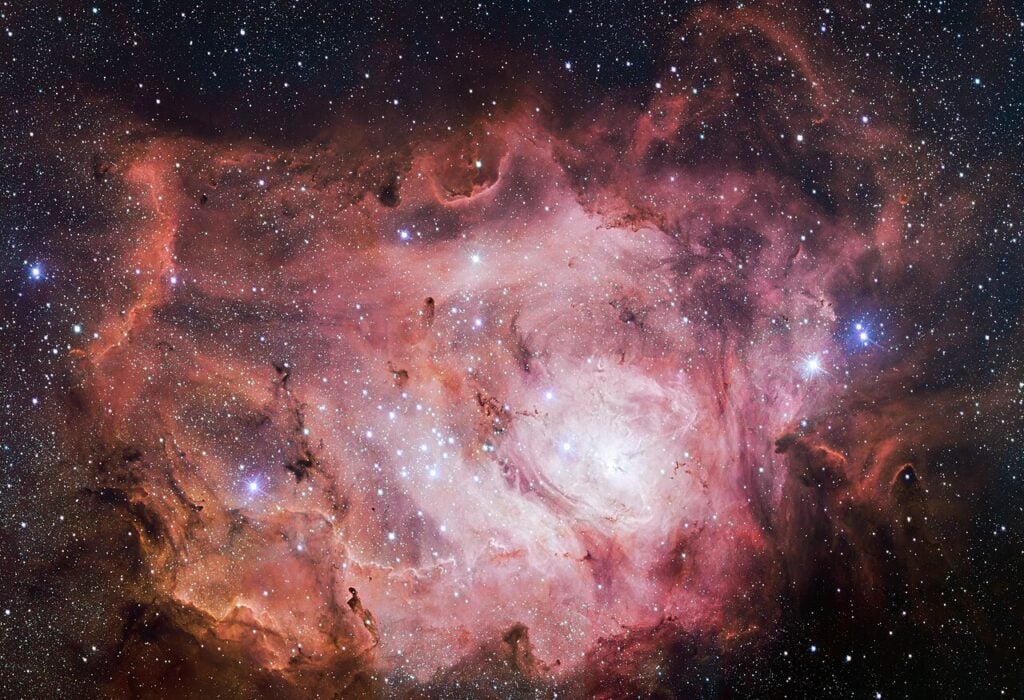
2: Lagoon Nebula
Coordinates: RA: 18h 03m 41s | Dec: -24° 22′ 49″
Type: Emission Nebula
Also known as: Messier 8
Distance: 6000 light years
Facts: The dust lane in the centre give the nebula its name. It is a stellar nursery, giving birth to new stars. It contains Bok Globules, which are like cocoons for early star formation.
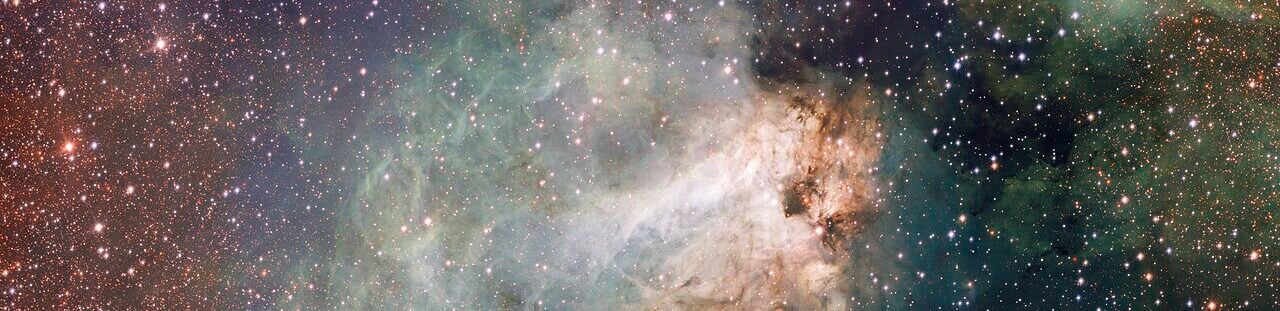
Appearance: Can be seen through binoculars. Through a 4-inch telescope with dark skies, you may see a cottony ball with a slash through the middle, with a collection of stars off-centre. Larger telescopes may reveal more detail and size to the nebulosity.
Image: By ESO/VPHAS+ team, CC BY 4.0
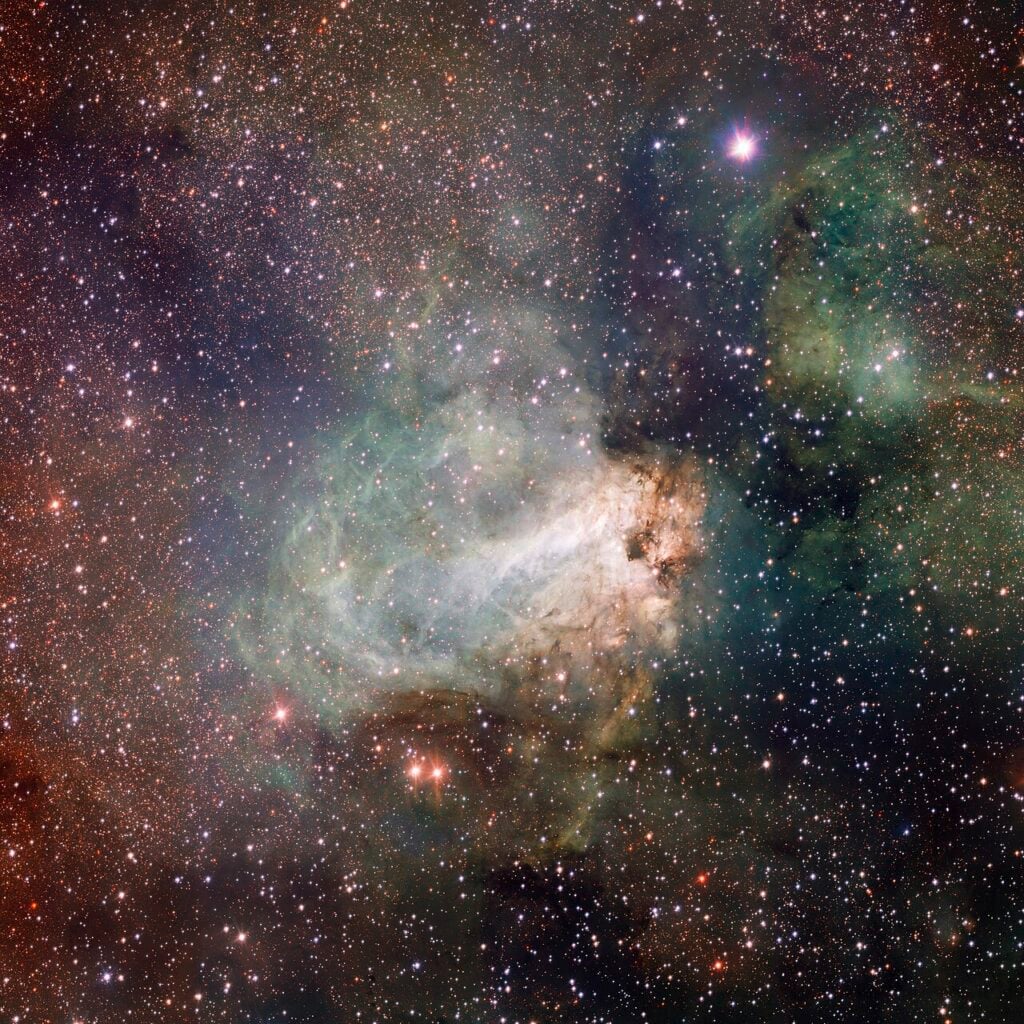
1: Omega Nebula
Coordinates: RA: 18h 20m 26s | Dec −16° 10′ 36″
Type: Emission Nebula
Also known as: Swan Nebula (as it looks like a swan visually through telescopes), Horseshoe Nebula, Messier 17
Distance: 5,500 light years
Facts: Its name is derived from Astronomer John Herschel who sketched it in 1833 and thought it looked like the Greek letter Omega. As with all stellar nurseries, it is packed with raw gas and dust that gives birth to hot, young stars.
Appearance: Through 4-inch telescopes, it will appear as a faint, grey smudge. Through 12-inch telescopes, the shape of a swan with surrounding dust cloud can be seen.
UCS or OIII filters will reveal more contrast.
Image: By ESO/INAF-VST/OmegaCAM. OmegaCen/Astro-WISE/Kapteyn Institute CC BY 4.0