This winter saw the ‘re-launch’ of the Radnorshire Mammal Group, led by County Recorder, Sorcha Lewis. British mammals are often secretive and with many of them nocturnal, it makes it difficult to spot and therefore record them. We could though do with more records of all mammals in Radnorshire, including grey squirrels, rabbits, badgers and moles. I shall focus on mice (families Muridae and Gliridae) for this article since the differences between the species can sometimes be misunderstood.
In Cwm Elan we have the wood mouse, yellow-necked mouse and almost certainly, the house mouse. Less common in Radnorshire is the hazel dormouse and the rarely found harvest mouse. And then there are the voles, which people sometimes confuse with mice but I won’t be covering them here.
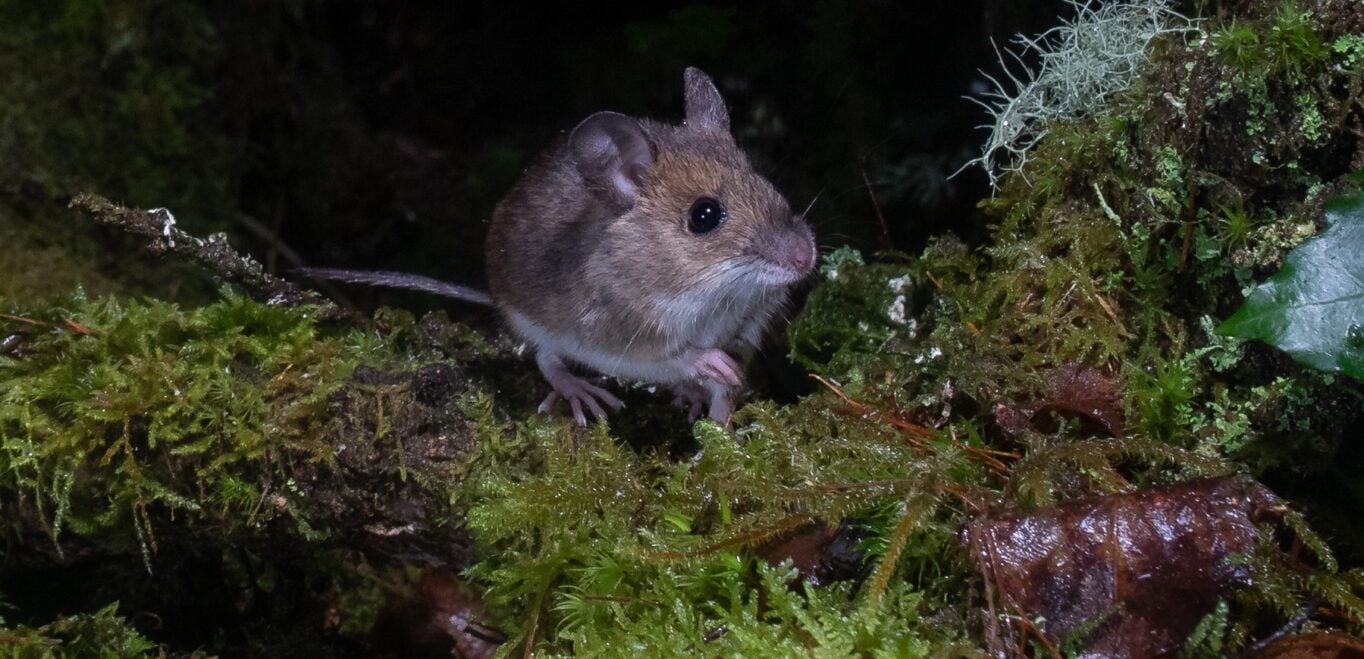
Most records in the valley are for wood mouse Apodemus sylvaticus. With a body length of between 8 and10 cm and tail the same length, the wood mouse is unsurprisingly found in woodland but also in rough grassland and gardens. The mouse has chestnut-brown fur with a white-grey belly and large back feet for leaping. I’ve sometimes found them overwintering in my bird boxes, in roundish ‘nests’ of autumn leaves.
The yellow-necked mouse Apodemus flavicollis is like the wood mouse, but generally larger, with a lighter, sandy-brown coat and collar of yellowish fur which forms a bib on its chest. Its ears have been described as large and paper-bag like! This mouse species is found in the more mature, deciduous woodlands but also in our gardens here.
Our house mouse Mus musculus is between 7 and 9cm long, uniformly brown-grey, with small feet, large eyes and ears and a pointed snout. It has an almost hairless tail, the same length as its body, and is characterised by its strong smell!
Dormice Muscardinus avellanarius are protected species and found in woodlands across Radnorshire – but we have yet to find them in Cwm Elan. With gingery-brown fur, large black eyes and a long fluffy tail, these mammals are between 6.5 and 8cm long. Dormice are nocturnal and spend most of their time in summer above ground in trees. They nest in patches of bramble (or nestboxes), weaving their nests from strips of honeysuckle bark and surrounding them with a layer of green leaves. In winter they hibernate at the base of old trees and hedgerows.
And lastly we have the tiny harvest mouse, Micromys minutus, 5-7 cm long and weighing just 4-6g. This mouse has golden-brown fur, hairy ears, a blunt nose and is the only British mammal with a prehensile tail which it uses like a fifth limb to hold on to grass stalks. Their sleeping and breeding nests are intricately woven from living grasses to form a distinctive sphere which is attached to sturdy stems. Preferred habitats of the harvest mouse include tussocky grassland, reed beds, hedgerows and woodland edges.
There will be a nocturnal woodland walk at our Cwm Elan Dark Sky Festival – 27-28th March.
Please record more mammals in Radnorshire – you can use irecord or send your records to: Sorcha Lewis: radnorshiremammalgroup@live.com
- Fiona Gomersall, Elan Valley Trust Ecologist