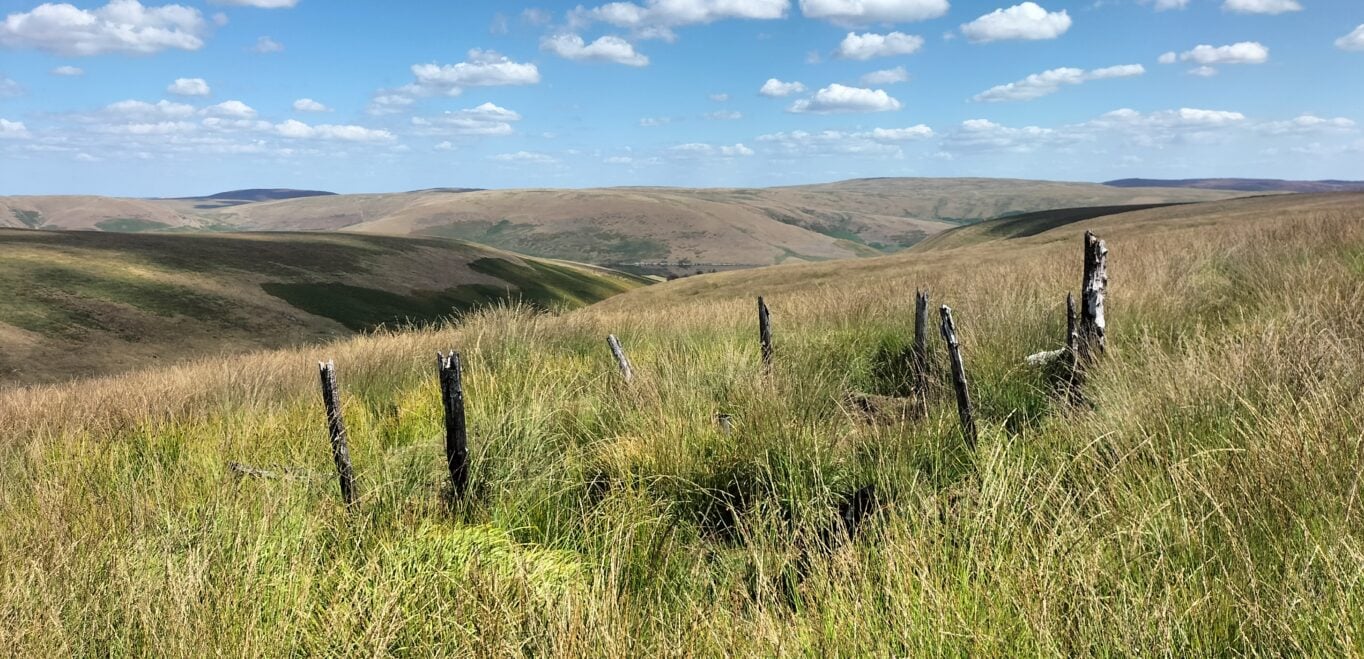
As you walk the hills of the water catchment of the Claerwen and Elan Valleys, you will have come across a small fenced-off square plot in the middle of nowhere or seen on an OS map the words “Rain Gauge” or “Rain-gauge” printed adjacent to a small dot or circle indicating its physical location.
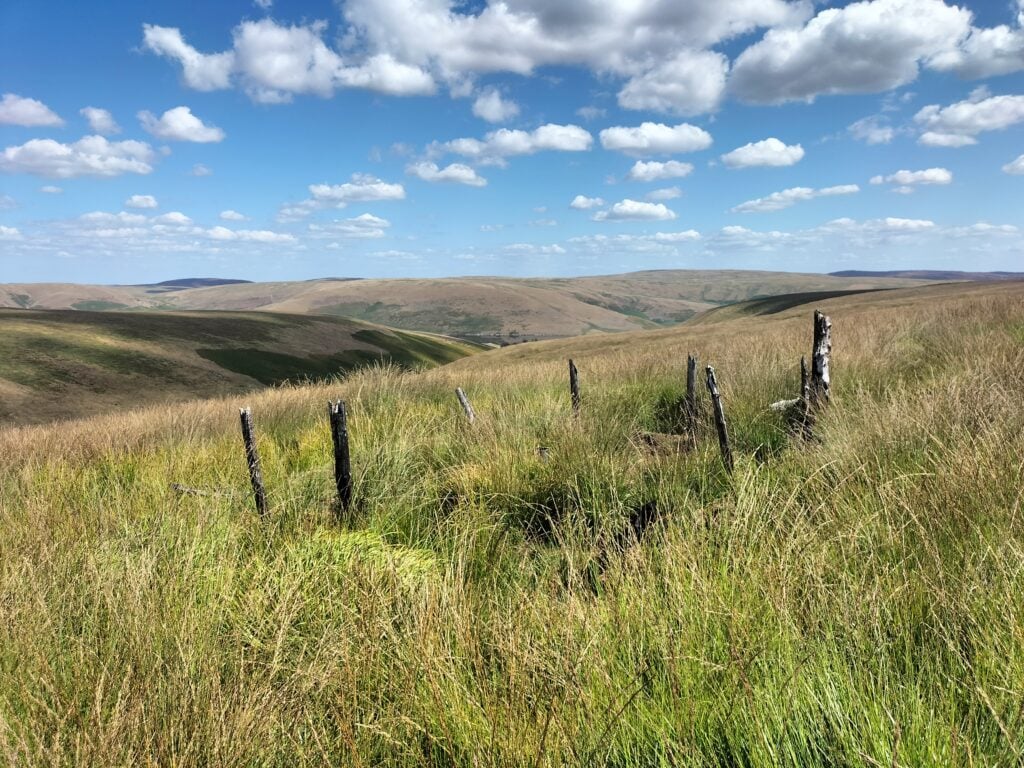
Rain gauges in the Claerwen and the Elan Valleys
As you walk the hills of the water catchment of the Claerwen and Elan Valleys, you will have come across a small fenced-off square plot in the middle of nowhere or seen on an OS map the words “Rain Gauge” or “Rain-gauge” printed adjacent to a small dot or circle indicating its physical location.
At one time, there were up to 30 rain gauges in total covering both valleys, with 15 in the Claerwen Valley and 15 in the Elan Valley.
Some of these were in very remote areas, only accessible by foot – a long hard walk over tussocks, or going on horseback with no direct footpaths – maybe the odd sheep track. Readings had to be taken once a month, on the first day of each month or as near as possible, in all weathers. A total of seven rain gauges had to be read daily; records show that in 1976 tenants were paid £15 a year for daily readings.
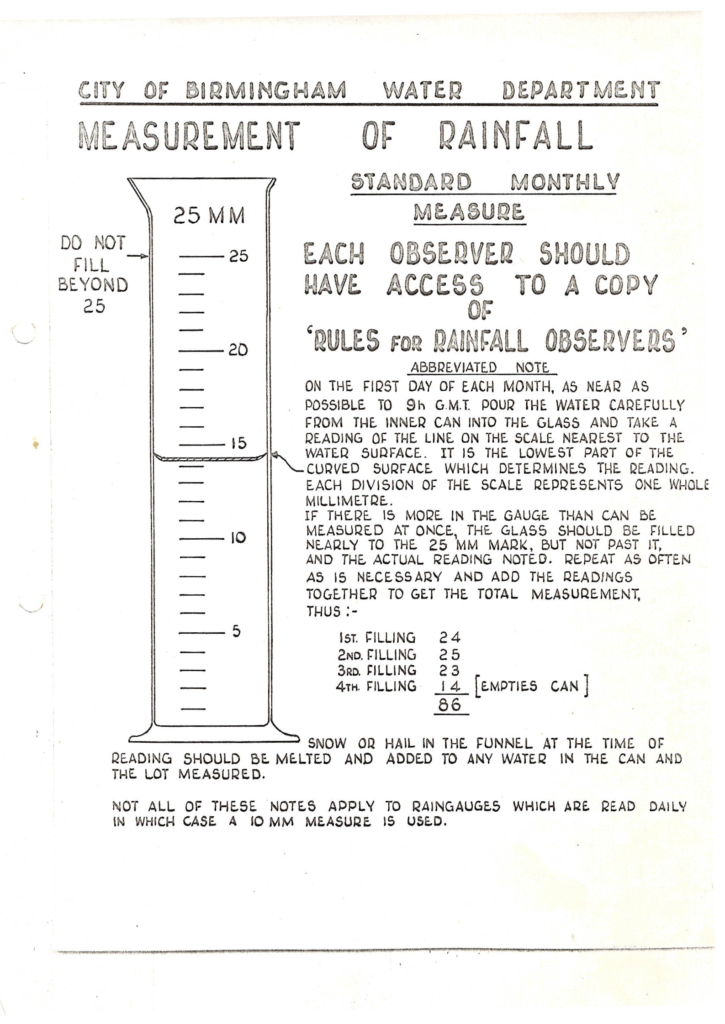
The rain gauge consisted of a metal cylinder set deep into the ground where the water was collected and then poured into a measuring glass, see poster below.
Gauge types used were: B= Bradford, S = Snowdon and O = Octapent
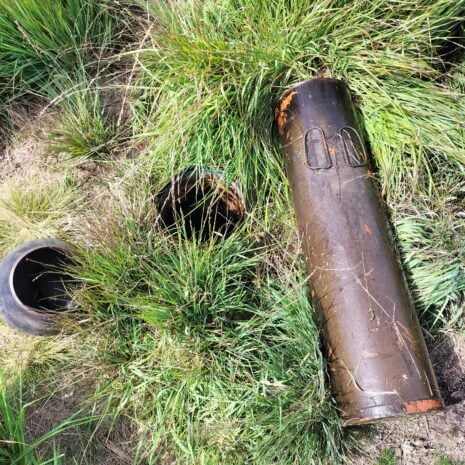
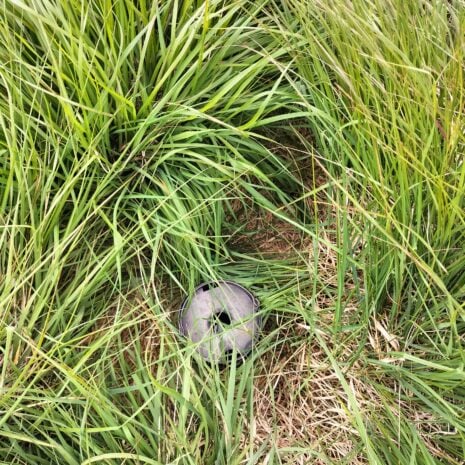
Examples of Rain Gauges
The readings were carried out by the farm tenant, or estate staff, the agent or superintendent. Readings were originally sent to the City of Birmingham Water Department.
A small token payment was given to the readers; the records show that in 1965, payment was made of up to £3 a year, and in 1975, as much as £10 a year.
Every two years, an officer from the City of Birmingham Water Department would inspect the gauges for possible leakages, check that any heavy growth of grass or rushes within the compound was cut back and inspect the boundary plot of the rain gauge for rotten or damaged fence stakes, which would be replaced by Water Board staff. At least on one occasion, it was said that the officer had to turn back, unable to locate the rain gauge due to fog on the hills, something that the farming tenants experience regularly, which can hinder rounding up the sheep on a gathering day.
The readers of the 15 rain gauges in the Claerwen Valley were:
- G. Edwards, Llannerch y Cawr – Esgair Ceiliog
- T C Edwards, Cerrigcwplau – Arban, Esgair Garthen, Nant y Car, Cors yr hwch & Llyn Carw
- I A Davies, Chapel House – Bwlch yr Hendre, Claerddu, Claerwen x 2, Cerrigllwydion, & Brynhir
- Estate Agent’s Staff – Esgair Gader
- Superintendent’s Staff – Tyrmyndd (read daily) & Ciloerwynt (read daily)
The readers of the 15 rain gauges in the Elan Valley were
- J Davies, Hirnant – Gwngu, Aberhenllan, Calettwr & Abercaethon
- Miss M Evans, Abergwngu – Abergwngu (read daily)
- W. Pugh, Bodtalog – Glan-Fedwen and Bodtalog (read daily)
- E.D. Evans, No 9 Elan Village – Tynllidiart
- Superintendent’s Staff – Tyn-y-pant, Tynant (read daily), Elan Village (read daily), Nantgwyllt (read daily)
- E.B. Rees, Penygarreg – Penygarreg 1, Penygarreg 2,
- Estate Agent’s Staff – Rhayader.
A review of the rain gauge network took place in December 1983, by representatives of the Met Office and the Water Authorities reducing the Elan/Claerwen gauges from a total of 24 to 7.
In the late 80s and early 90s, the only rain gauge readers were: Bonny Rees of Penygarreg, me, Tudor Davies of Chapel House, who discontinued readings at the end of 1992 and the last man standing carrying out the readings was Mr David Williams of Abergwngu, who retired in 1995/96.
I believe four live environmental monitoring stations, as they are now known, are managed by Natural Resources Wales in this area:
- Elan Village
- Nantgwyllt
- Tynant, Troedrhiwdrain
- Ciloerwynt
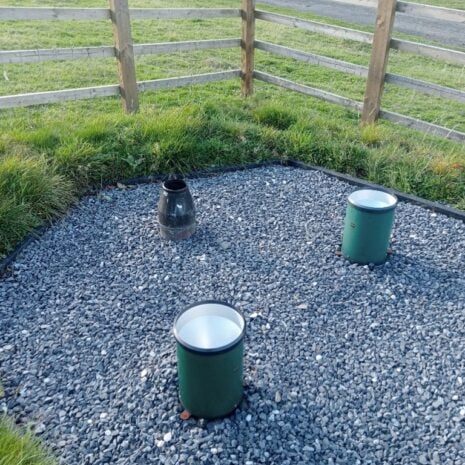
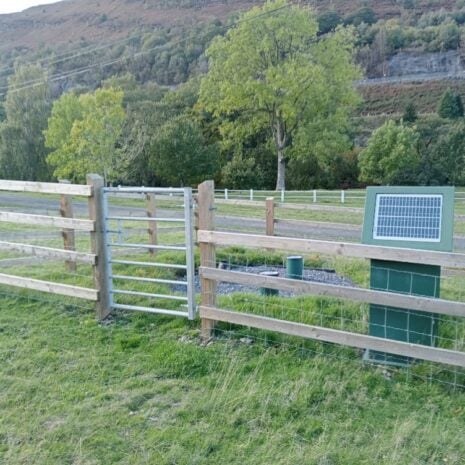
Rain Gauges, Elan Village
How times have changed! Today, only a handful of rain gauges remain in the water catchment. Rain gauge readers do not have to climb over a stile into the fenced-in plot now; a small gate is installed, and all are easily accessible – there are no remotely-located ones where Health & Safety would probably not permit anyone to walk miles to an area with no mobile reception.
Tudor Davies
Walk Leader and Local Guide